convertfilepro.com

AI & Machine Learning

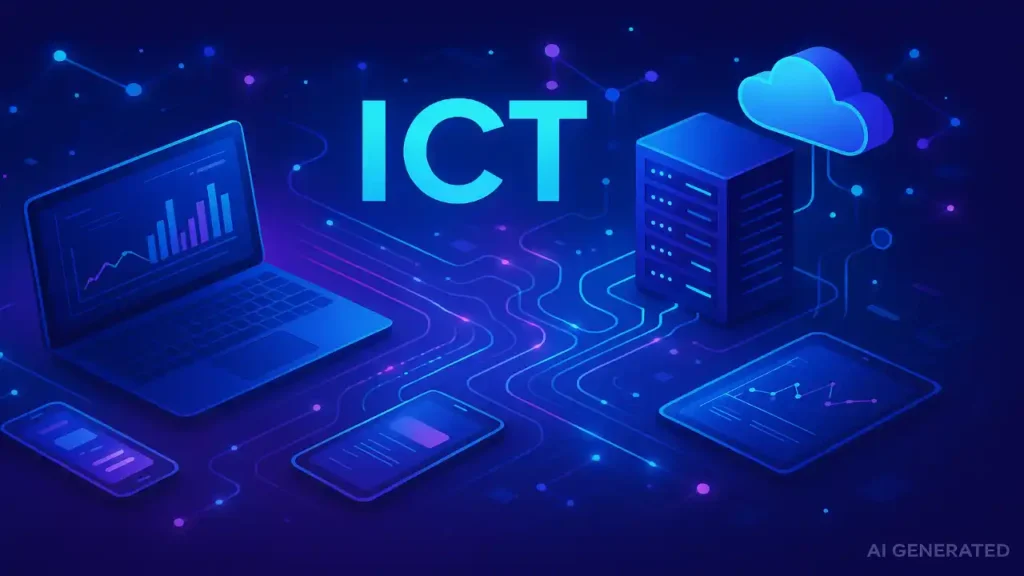
"Illustration of Information Communication Technology (ICT) showing interconnected devices like laptops, smartphones, tablets, servers, and cloud icons with data streams, glowing network nodes, and futuristic digital interface elements.
AI & Machine Learning, Tech Trends & Innovations

What Is Information Communication Technology? A Complete Beginner-Friendly Guide

Have you ever noticed how much technology we use every single day without thinking?Morning phone check, WhatsApp good morning, opening the laptop, scrolling Instagram, searching something on Google… and we don’t even realize that all this belongs to one big concept: what is the information communication technology. It looks like a simple question, but its answer is actually deep and interesting. And honestly, if you understand the real meaning of ICT, you will understand the whole game of technology. In this guide, I am explaining everything in a beginner-friendly way — just like I explain things to a friend while having tea. So let’s start. Read Also : AI vs Humans: Skills You Must Learn to Stay Relevant in the AI Era What Is Information Communication Technology? (Human-Friendly Explanation) The simple answer: Information Communication Technology (ICT) includes all the technologies that help to process, store, transmit, and share information. It is an umbrella term that includes: Meaning: Understanding this concept is important because it is the backbone of the digital world. Understanding ICT in simple words: Definition of Information and Communication Technology Textbook definition:“ICT refers to the technology systems used to manage, access, transmit, and communicate information.” But in simple human words:ICT is everything that makes communication fast, digital, and smart. Key points from the definition: Meaning of ICT (Easy Breakdown) Many people get confused about the meaning of ICT.Simple answer → ICT means Information and Communications Technology. Its main purpose: More simple meaning: What ICT Stands For (Basic Concept) Common question in exams, blogs, and interviews:What does ICT stand for?Answer: Information and Communications Technology This term became popular in the 1990s when computers and telecom started coming together. Why this term matters: Types of ICT Systems People think ICT systems mean only computers.But the scope is much bigger. Major types of ICT systems: Short explanation 1. Communication SystemsSystems that exchange messages — like email, chat apps, VoIP, and video conferencing. 2. Computing SystemsSystems that process information — laptops, PCs, and servers. 3. Data Management SystemsSystems that store, retrieve, and secure data — databases and data centers. 4. Network SystemsSystems that connect devices — routers, switches, LAN, and WAN. 5. Internet & Cloud SystemsSystems that offer online access and storage — cloud apps and hosting tools. 6. Telecommunication SystemsMobile networks, telephone lines, and satellite systems. 7. Multimedia SystemsAudio, video, and graphics — all part of ICT. ICT Tools and Examples (Very Important Section) When someone says “ICT tools,” they mean the digital tools used to share or process information. Most popular ICT tools: Short explanation: Digital Communication Technologies (Modern Examples) Today, almost 95% of communication happens through digital tools.All thanks to ICT. Most-used digital communication technologies: Why these technologies matter: Computer and Communication Technology Computer technology + communication technology = core of ICT This includes: Short explanation: Advantages of ICT Without ICT, business, schools, hospitals, banking — nothing would work today. Main advantages: Impact of ICT on Society ICT has changed society in both positive and negative ways. Positive impact: Negative impact: Future of ICT (Why It Matters Now More Than Ever) In the coming years, ICT will become even more powerful.AI, IoT, automation, 5G, cloud — all are part of ICT’s future. Future changes expected: Conclusion (Friendly Closing) Now when someone asks “what is the information communication technology”, you can explain easily — because ICT is the combination of technologies that make our life fast, connected, and digital. Whether it is business, school, office, or personal life — nothing is possible without ICT. And as technology grows, ICT will keep becoming more important. FAQs Sources: https://www.intertek.com/ict/https://ccitraining.edu/blog/what-is-ict-a-deep-dive-into-information-and-communication-technology/https://en.wikipedia.org/wiki/Information_and_communications_technologyhttps://online.nccu.edu/blog/what-is-information-communications-technology/https://csrc.nist.gov/glossary/term/information_and_communications_technology
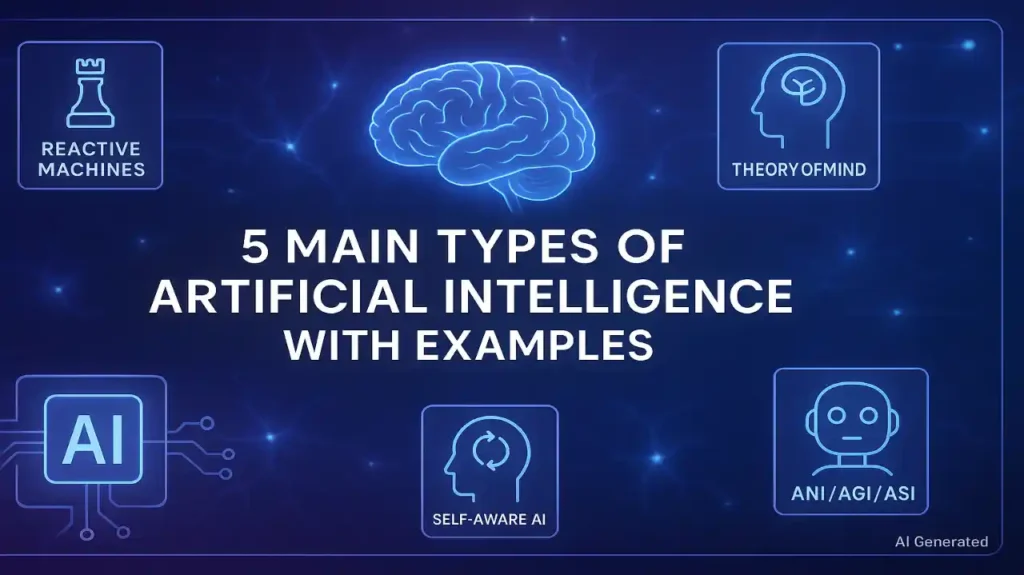
AI banner showing the 5 main types of artificial intelligence with examples in a futuristic design
AI & Machine Learning

AI vs Humans: Skills You Must Learn to Stay Relevant in the AI Era

Sometimes this thought must have come to your mind too — “Yaar… can AI replace humans in future? And if it does, then what will we do?”Honestly, this question is asked by almost everyone these days, and I also went through the same confusion. Because AI is growing so fast that sometimes it feels like machines are becoming smarter than us. But then the next moment it feels — yaar, replacing humans fully is not that easy. In this blog, I am going to explain the same things that I have seen in real life.AI is strong, fast, and smart… but the depth, feeling, and judgement that the human brain has — AI is still very far from that.But yes, one thing is true:If we don’t learn the right skills, then AI will surely leave us behind. So, no extra gyaan… let’s simply see step-by-step which human skills are most powerful in the AI era.And yes, I am naturally using the focus keyword “can ai replace humans in future” so SEO stays perfect. Read Also : Can AI Really Replace Humans? 7 Surprising Industries Where Machines Are Taking Over Reality Check – Can AI Replace Humans in Future? Look, the simple truth. AI will replace many tasks. That is true.But not humans. Machines will take over repetitive work like:● data entry● pattern recognition● reports● basic content● routine customer queries But the work that needs mind + emotion + judgement, AI can never fully control. That’s why when people ask “can ai replace humans in future?” my simple answer is:No yaar… but it will replace your old skills.It means humans will remain, but the race of skills will become tough. And that’s why the topic of future skills becomes important. Future of Artificial Intelligence – And Where Do Humans Fit? AI’s future is solid, no doubt. It has entered every field —healthcare, finance, marketing, education, everywhere.But the future of AI is not opposite to humans, it is growing side by side with humans. This combination is called augmented intelligence, and this will be the main concept in the future of artificial intelligence. Human Skills vs AI – Who Will Win? To be honest, both will win — but in different roles.AI will win in speed.Humans will win in feelings and judgement. But if humans develop the skills where AI is weak, then the game is in our pocket.Now I will explain those skills that are most in demand in the AI era. Must-Learn Skills to Stay Relevant in the AI Era So let’s directly come to the skills.I have kept simple H3 sections so you can understand easily. 1. Critical Thinking – Power to Think Above the Machine AI can give facts, it can create logic.But critical thinking — real reasoning — only humans can do. Critical thinking means:● looking at a situation from different angles● not following data blindly● choosing the right decision Today a strange trend is going on — people believe AI’s output as the final truth.But the smart person is the one who confirms AI’s answer, questions it, and cross-checks it. If you become a critical thinker, then AI cannot replace you. 2. Creativity – The Human Touch AI Can Never Copy See, AI can create content, generate images, make designs.But one thing —AI copies.Humans create. Creativity does not mean being perfect.Mistakes also create creativity.Life experiences bring creative thoughts. That’s why people who are learning writing, design, imagination, storytelling, marketing, branding — they are becoming future-proof. 3. Emotional Intelligence – This Skill AI Has Zero AI does not understand emotions. It only reads text patterns.But humans…● feel● empathize● connect● understandThis ability is the heart of every industry. Managers, leaders, teachers, counsellors, HR, business owners — everywhere human touch wins. 4. Problem Solving – Where Logic + Emotion Both Are Needed AI can solve problems only when everything is based on data.Real-world problems are messy.● incomplete data● different opinions● emotions involved● unpredictable results AI gets confused.Humans adjust. That’s why problem-solving is one of the most valuable skills in the AI era. 5. Adaptability – The Skill to Survive in a Fast-Changing World This skill looks simple, but it is the toughest.“I work like this only… don’t teach me new tools.”With this attitude, people automatically get removed from the future. In the AI era, the successful person will be the one who:● tries new tools● adopts technology● isn’t scared of changes● learns fast Who adapts — goes ahead. 6. Strategic Thinking – AI Will Execute, But Humans Give Direction AI executes.But direction, planning, strategy — humans create.And this is the main difference in AI vs humans. Companies do not want only AI engineers; they want AI strategists.The person who can use AI to improve business — that person is a golden asset. 7. Communication & Teaching – Pure Human-Based Skills AI can never copy communication skills.Human voice, human touch, human explanation — these cannot be replaced. AI can give information.But understanding, comfort, guidance — only humans give. In the coming time, teaching, coaching, consulting, training — all these fields will grow even more. Why “Human Skills vs AI” Is the Real Future This whole game is not about competition, it is about combination.Today companies want people who have both:● knowledge of AI tools● human value-based skills In one line —AI can be your assistant. Not your boss. If you learn the right skills, your answer will always be the same:No, can AI replace humans in future? No boss… but growing with AI is important. Conclusion AI Will Not Replace You, But It Will Make You Upgrade In the end, I will say only one thing…Don’t be scared of AI.Learn how to use it. AI will replace people who don’t move forward.But those who build learning, creativity, critical thinking, and adaptability —AI will make them even more powerful. The future belongs to those who see AI not as a competitor, but as a partner. FAQs

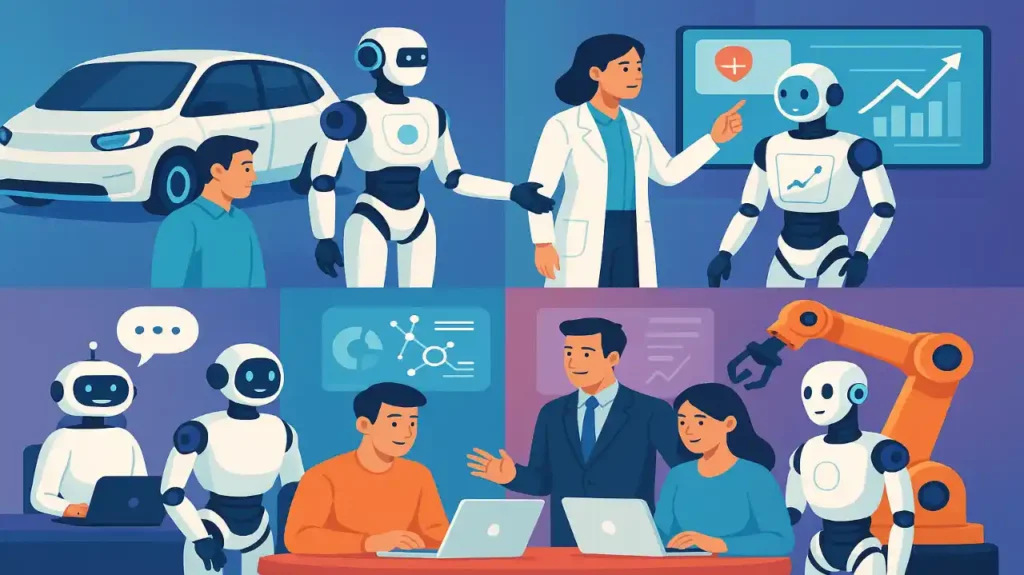
Can AI replace humans in future – humans and AI collaborating across 7 industries with automation and AI technology in workplace
AI & Machine Learning

Can AI Really Replace Humans? 7 Surprising Industries Where Machines Are Taking Over

Guys, honestly, these days you hear this question everywhere: “can AI replace humans in future?” And honestly, it feels a bit stressful too, right? Like, what will happen to our jobs, who will work, and who will chill? But relax, I will explain this topic today in a simple way with real-life examples, just like we discuss on YouTube. In this article, we will see 7 industries where AI is already doing humans’ work, and also understand which tasks AI can do and which tasks are still reserved for humans. Read Also : 5 Main Types of Artificial Intelligence With Examples Future of Artificial Intelligence: Not Just Sci-Fi First, let’s set some context. AI technology in future is not just robots working in offices or factories. These are smart algorithms, chatbots, and predictive tools that guide our life and businesses. Think about it, we are using AI in workplace everywhere — filtering emails, scheduling meetings, or solving customer queries. This is all the magic of automation and AI. And yes, when we think about “will AI take over human jobs,” the answer is not simple. AI can do some tasks, not all, and in some tasks humans and AI work together to get the best results. 1. Retail and E-Commerce: Machines Controlling Checkout Think, when does and how Amazon recommend products? This is a classic example of AI impact on jobs. In retail, AI is not just improving shopping experience. It is managing inventory, chatbots are solving customer queries, and robotic arms in warehouses are sorting packages. AI replacing human workers happens in warehouse and logistics. Humans are still handling decision-making, strategy, and complex customer problems. Here, you can clearly see AI vs humans balance — both working together give better results. 2. Healthcare: Robots and Algorithms in Scrubs Healthcare might surprise you. AI is not just helping in surgeries or diagnosis, it is also doing routine checks and predictions. AI is analyzing X-rays and scans. It predicts patient outcomes. It makes drug discovery and research faster. Yes, humans are not completely replaced. Doctors’ empathy and judgement are still critical. AI and human collaboration works perfectly here. Doctors are using AI tools to make better decisions. 3. Finance: Machines Crunching Numbers In the finance sector, AI impact is quite high. Algorithms detect fraud, automate trades, and generate reports. AI in workplace is analyzing data and predicting trends. Financial advisors and analysts are still managing market nuances and customer relationships. Think about it, here also AI replacing human workers is partial. Humans and machines work together to make smart decisions. 4. Journalism and Content Creation: Robo-Reporter Era Journalism might seem surprising, but the truth is news agencies are using AI: Here, human vs machine intelligence is visible — mundane tasks are done by AI, but creative and investigative reporting is in humans’ hands. 5. Manufacturing: Robots on Production Lines In manufacturing, AI and robotics are already working: But humans are still troubleshooting and maintaining machines. This is a clear example that AI vs humans combination gives the best results. 6. Transportation and Logistics: Self-Driving Vehicles You must have heard about self-driving cars and trucks. AI algorithms analyze traffic and optimize routes. Delivery robots and drones are working in warehouses. But complex decision-making, emergency situations, and human touch are still needed. This sector clearly shows automation and AI work effectively only with humans. 7. Customer Service and Support: Chatbots Everywhere In customer service, AI impact is most visible. Here too, AI and human collaboration is creating a smooth experience. Skills Humans Need in AI Era Now that we have seen how AI in workplace is growing, let’s talk about what humans can do: Basically, embrace AI and human collaboration, don’t fear it. Conclusion: Balance is the Key So Guys, can AI replace humans in future? In short: “Some tasks yes, humans completely no.” AI is powerful, but humans’ creativity, empathy, and decision-making are critical. Remember, this human vs machine intelligence debate is not just competition. It is an opportunity for collaboration. Embrace it, learn the right skills, and make AI your ally. FAQs

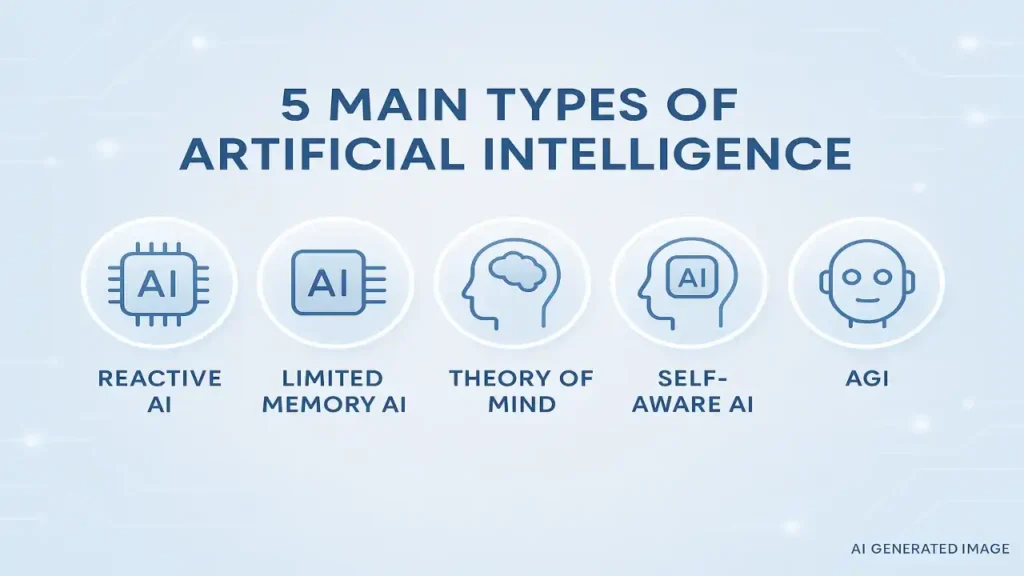
Illustration showing the 5 main types of artificial intelligence with examples, including reactive AI, limited memory AI, theory of mind, self-aware AI, and AGI, displayed with simple icons on a light blue background.
AI & Machine Learning

5 Types of AI and Real-Life Examples You Already Use Every Day (But Don’t Realize)

Introduction Have you ever noticed… we hear about AI almost every single day, but we rarely realize how much of it we actually use. In fact, without even thinking about it, we interact with multiple AI features daily — and most of them belong to the 5 main types of artificial intelligence with examples that we’re going to explore in this blog. And that’s the reason… when I was writing about “5 main types of artificial intelligence with examples”, I felt that explaining it in a fully technical way would become boring. Because mostly, people get confused about how many types of AI exist, how they work, and where they are used in real life. So in this blog, I’m explaining everything — types of AI in simple words, in a human style, in a friendly tone — just like I’m sitting with you and telling you directly.And yes… I’m making sure the content is non-promotional, natural, a little imperfect (like humans write), but useful. So let’s start. Read Also : How to Choose the Best AI Course for Project Management Understanding the Categories of Artificial Intelligence (Human Style Explained) AI feels difficult only when the definitions become heavy. But when you understand its categories in simple language, everything becomes crystal clear. Usually, 5 types of AI are discussed, and each type has a different role in daily life. In this blog, you will not only learn the categories, but you will also get artificial intelligence examples in real life… which you might not know till now. So let’s understand each one step-by-step. 1. Reactive Machines – The Most Basic Type of AI Reactive machines are AI systems that only “respond”.They don’t store past memory, and they don’t make predictions for the future.They simply look at the real-time input and give a response based on that. Think like this:If you open a calculator and press 12+8… the calculator only gives you the answer. It doesn’t think about what you calculated before. Real-Life Examples (You Already Use Every Day) All these are part of reactive AI.Simple, direct, no memory. 2. Limited Memory AI – The Type We Use Constantly Without Realizing Have you ever thought how your phone camera’s portrait mode blurs the background so cleanly?Or how Netflix recommends new shows based on your past choices? This is limited memory AI. This AI stores past data and uses it to improve decisions.We use this type every single day… without realizing. Artificial Intelligence Examples in Real Life (Limited Memory AI) Actually, most AI systems we use daily belong to the limited memory category. 3. Theory of Mind AI – The Future Type (Still in Development) Now here… pay a little attention.This type doesn’t fully exist yet, but its development is happening constantly. Theory of Mind AI aims to understand humans with “emotion + intention”.Like your mood, your reaction, your tone… it should understand all of this. Right now, AI only understands text, not feelings.But in the future, AI will read human emotions. Imagine this — if you speak in a sad voice to a device, it automatically suggests calm music.Exciting, but a little scary too. Real-Life Early Examples (Not Fully Mature Yet) All these are still in early stages. 4. Self-Aware AI – Theoretical Category (Not Real Yet) Self-aware AI would be something that understands itself, understands its own emotions… basically becomes conscious. Honestly, this type of AI only exists in movies right now.In the real world, it does not exist. Examples?Movie ones — like Iron Man’s JARVIS, or any robot that makes its own decisions. When people talk about narrow AI vs general AI, self-aware AI is seen as “beyond general AI”.General AI is like human-level intelligence… and self-aware is even above that. For now, it is only theory, not reality. 5. Artificial General Intelligence (AGI) – The Human-Level AI Now the most confusing part…People think ChatGPT or any smart system is AGI. But no. AGI is an AI that can think, understand, reason like humans.Meaning, if you expect it to handle cooking, maths, driving, emotions, planning — everything equally well — then that is AGI. Today, no AI is 100% AGI.But work is going on. Possible Early Examples (Still Not Fully AGI) AGI’s goal is to achieve human-level general intelligence. Now Let’s Combine Everything — 5 Main Types of Artificial Intelligence With Examples (Full Summary) Here is a quick and simple summary to make your concept fully clear: 1. Reactive Machines 2. Limited Memory AI 3. Theory of Mind AI 4. Self-Aware AI 5. Artificial General Intelligence This whole framework covers your “5 main types of artificial intelligence with examples”. Why Most People Don’t Realize They Use AI Daily To be honest, AI has become so smooth that we don’t even feel like any technology is working behind it.We think “AI means robots”… but in reality, AI mostly works inside software and digital systems. That’s why you keep using AI without noticing. Some examples you already use without realizing: None of this is possible without AI. Narrow AI vs General AI — The Simplest Explanation Ever You must have heard these terms many times, so let me explain in the easiest way. Narrow AI (ANI) Examples: General AI (AGI) Examples: Why Understanding AI Types Matters Today Today, AI is everywhere and people usually get confused about what’s real and what’s just marketing.When you understand the categories of artificial intelligence, you can easily judge how powerful an AI system really is. And if you are in tech, digital marketing, business, or content creation… knowing the types of AI helps you make smarter decisions. Conclusion So finally, we covered: AI is not complicated… people only make it sound complicated.Once you understand the basics, you’ll realize that AI has already become a normal part of our daily routine. And with this same friendly, simple tone, I explained the complete “5 main types of artificial intelligence with examples” to you. FAQs

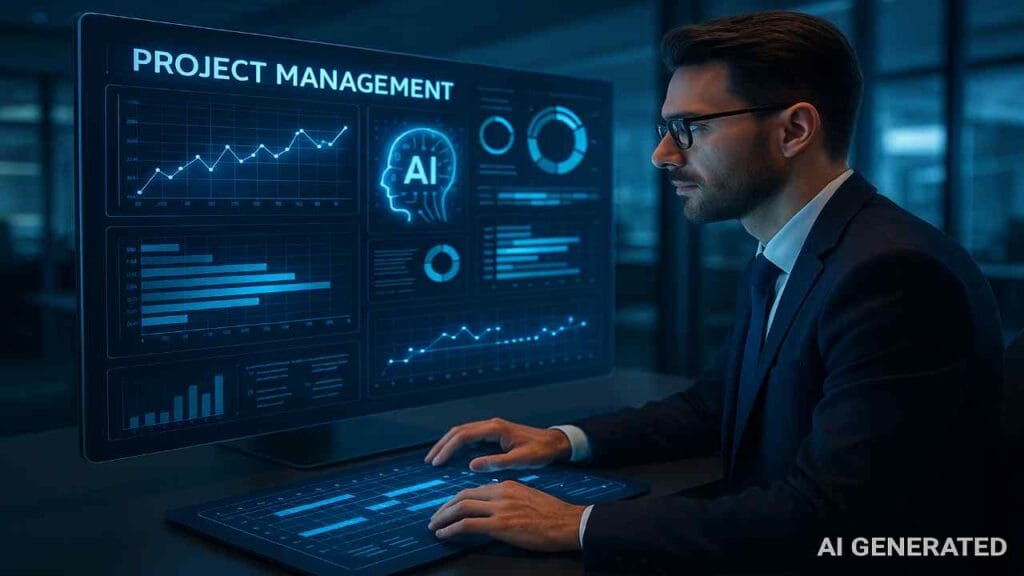
Project manager using AI tools on a laptop with clean minimal icons in a light professional background.
AI & Machine Learning, Career

How to Choose the Best AI Course for Project Management

To be honest, today when any project manager asks me — “Which AI course is best for project management?” — I say only one thing:“The course that actually solves your real project problems, not the one that only teaches fancy AI knowledge.” Because that’s the real game.Course length, platform name, certificate shine… all these are secondary. If a course cannot make your planning, execution, risk prediction, and daily workload easier, then honestly it is useless. Today AI is everywhere in project management, but that doesn’t mean every course is useful for you. So in this blog, I will explain everything in a simple, human way, like talking to a friend. I will tell you how to choose the best AI course, what to check, and how to know if the course will actually help your career. Read Also : What Are the Future Points for AI? Key Predictions for 2030 Why This Question Actually Matters “Which AI course is best for project management?” — this is not just a search question. It’s a real need. Because AI has changed project management completely. Now deadlines don’t run on guesswork.And now resource planning is not based on gut feeling.Now risk prediction doesn’t depend on Excel formulas. AI is performing so well that project managers who are not using AI are becoming less effective than those who are using AI. That’s why choosing the right course matters — a wrong course will waste time, and the right course will make you a next-level manager. AI Project Management Training Path This “AI for project managers” training path is not complicated. Only three things matter: If a course teaches you how AI helps in: …then the course is worth it. How to Identify the Best AI Course for Project Managers Now I will give you the practical points that help you choose the right course 100% correctly.This becomes your roadmap — which course to pick and which one to avoid. 1. Does the Course Teach Real Project Management Scenarios? See, anyone can teach theory.But the real value comes when the course shows: If there are no real examples, learning becomes half.The best course is the one that solves your daily PM problems using AI. 2. Is the Course Teaching AI Tools or Only Theory? Project managers don’t need coding.They need: If the course teaches real tools and gives hands-on practice — perfect.If it only gives concepts — skip it. 3. Does the Course Improve Your Core PM Skills? The best course is the one that improves your main PM skills: And when AI is added to these skills, your performance can double. This point also answers your focus keyword:“Which AI course is best for project management?”→ The one that gives both PM + AI skills together. AI-Powered Decision Making for Managers The biggest challenge in project management is decision making.And AI helps the most in this area. A good AI course teaches you: If the course doesn’t cover AI-based decision making, then the course is incomplete. 4. Certification Should Be Valuable (AI in Project Management Certification) A certification should be there — but not just for name.A valuable certification: But remember, complicated technical courses are not meant for project managers. 5. Course Should Be Beginner-Friendly and Practical Project managers are already busy.If a course is too technical, you will drop it halfway. The course must have: Only then will AI fit into your daily work. 6. Check Real Feedback — Did People Actually Improve? Reviews like “great course” don’t matter.You must check: If yes, then the course is worth it. Artificial Intelligence for Project Management Training — What Must It Include? A good PM-focused AI course must include: Without this combination, the course is incomplete. Benefits of Choosing the Right AI Course for Project Management If you choose a solid course, you can expect: These are real benefits, not hype. Avoid These Mistakes While Choosing an AI Course Many people make these mistakes: Avoid these and you will pick the right course easily. Conclusion — So Which AI Course Is Best for Project Management? If I answer in one line: “Which AI course is best for project management?”→ The course that teaches you how to use AI in project planning, execution, deadlines, team management, and prediction in real life. The course name doesn’t matter —The course impact matters. Choose a course that is: Remember this formula, and you will never waste time on the wrong course.

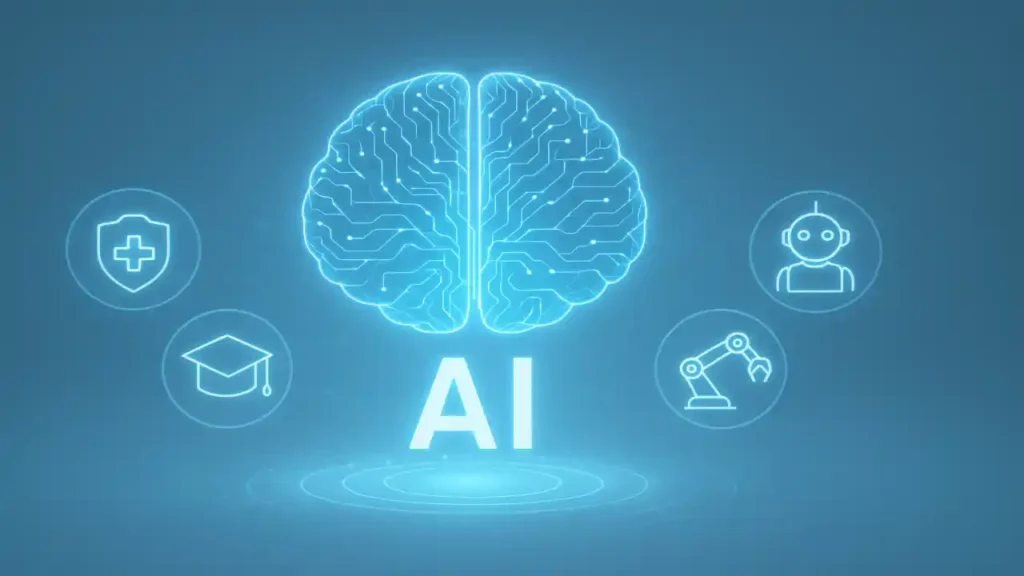
Digital brain illustration showing future points for AI with icons of healthcare, education, robotics, and automation in a glowing blue theme.
AI & Machine Learning

What Are the Future Points for AI? 10 Real Trends You’ll Actually See in the Next 5 Years

Sometimes we hear so much about AI that we start thinking… “Guys, what is actually going to happen in the future?” But honestly… in real life, we just want simple clarity.Exactly What are the future points for AI? — meaning what real changes AI will bring in the next 5 years that we can actually see? In this blog, I will explain everything in a simple, human style.No fancy words, no confusing predictions.Just those 10 real emerging AI trends that you will actually feel in your daily life. Read Also : Why did AI suddenly become so popular? The Future of Artificial Intelligence — What’s Actually Coming Next? When people talk about the future of AI, they imagine things like space-level robots, flying cars, and all that.But the real picture is simple and more practical.AI’s future means technology will slowly become smarter, and our daily life will become smoother. And honestly, the answer to “What are the future points for AI?” is very simple: AI will take our life to the next level with speed, accuracy, and personalization. Now this “personalization” will come from where? How will it work?We will cover all this below. Read also : What Is the Future of AI After 5 Years? Explained Simply 1. AI Becomes Extremely Personal — Like It Actually Knows You In the next 5 years, the biggest change will be hyper-personal AI. This means AI will understand your emails, your choices, your mood… everything.And then give you perfect suggestions. Whether it’s shopping or watching videos Writing emails or managing your schedule Fitness plans or learning style AI will adjust according to you — and this will be one of the most powerful future points. And yes, throughout this discussion, our focus keyword “What are the future points for AI?” fits naturally. 2. Upcoming AI Technologies Will Automate Everyday Small Tasks This may sound simple, but trust me… automation of small tasks will be a major trend. Today these things feel basic, but in the next 5 years AI will become so smooth that you won’t even notice when your work gets done. This is also a strong point when someone asks: What are the future points for AI?Because the biggest impact will be on daily small tasks. 3. Next Generation AI Will Become Multimodal Like Humans Right now AI understands text, voice, and images — but separately.In the future, it will combine everything like humans. Imagine: Show a photo and say: “Make it look like a cartoon.” You speak your idea and AI creates the whole document. You give a rough idea and AI generates a 3D model. Next generation AI will do all this by seeing + understanding + creating at the same time. This is one of the strongest future points. 4. AI Will Improve Healthcare in a Way We Never Imagined AI will change healthcare completely. Some things are already happening, but in the next 5 years you’ll see: And honestly, when people discuss What are the future points for AI?,healthcare cannot be ignored — because this is where the biggest real impact will come. Read Also : What Is the Main Goal of AI in Today’s World? 5. AI + Creativity Will Change How We Work (No, It Won’t Replace You) One big myth is that AI will replace everyone.The truth is — AI will give superpowers to creators, not replace them. In the coming time, AI won’t be just a tool — it will be a co-creator. You give the starting idea… AI will make it 10x better.You give a rough sketch… AI will create the final design. In the creative world, upcoming AI technologies will bring huge speed and improvement. 6. AI Will Make Cybersecurity 100x Smarter Cyber threats are increasing so fast that manual monitoring is not enough. In the next 5 years, you cannot imagine security without AI. The future internet will be safe — only because AI is becoming the smart guard. 7. AI Will Transform Education Into Personalized Learning The entire education system will change — in a good way. Today, one teacher teaches 50 students in the same way.But with AI, learning will become fully personalized: That’s why whenever I explain What are the future points for AI?,education always becomes one of the biggest changes. 8. AI Will Be in Everything — Devices, Cars, Appliances, Even Clothes The future is simple — AI will be everywhere but you won’t even notice it. Next generation AI will make: Even clothes will have sensors + artificial intelligence for health monitoring. This is a strong emerging AI trend. 9. AI + Robotics Will Boost Real-World Automation Robots won’t be limited to factories anymore.In the next 5 years you’ll see: This is the real combination of AI + the real world. 10. AI Laws, Ethics & Regulations Will Become Standard Everywhere As AI becomes more powerful… we will need more rules. Governments will create: So when people ask What are the future points for AI?,one major point is — future = regulated and responsible AI. Emerging AI Trends in the Next 5 Years In the next 5 years, emerging AI trends will reshape the tech world.artificial intelligence will come close to human-style reasoning and solve real-world problems faster. Upcoming AI Technologies You Must Watch These upcoming artificial intelligence technologies will make daily work much faster.Like smarter assistants, multimodal AI, real-time automation, predictive systems — all will upgrade fast. Conclusion: The Future of AI Is Real, Practical, and Already Starting If I say it in simple words:What are the future points for AI? The answer is —Artificial Intelligence will make life smarter, faster, and more personal. The next 5 years are not science fiction.They are full of real, practical changes: The future of AI is not scary…It’s just a new version of life — and honestly, it’s exciting. FAQs

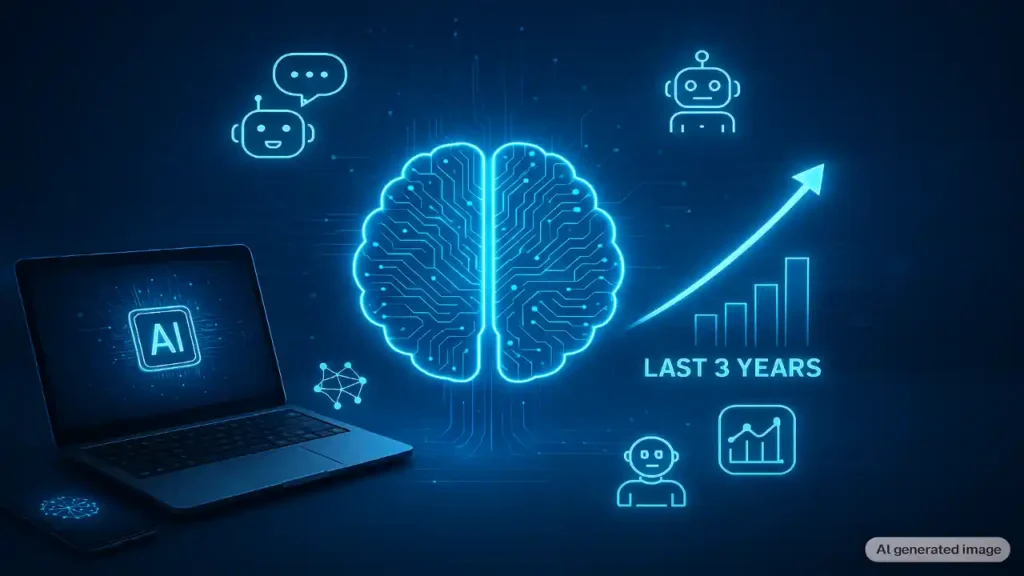
Futuristic AI banner with glowing neural networks, holographic data streams, and digital brain representing AI popularity
AI & Machine Learning

Why Everyone Is Suddenly Talking About AI: What Changed in the Last 3 Years?

Have you noticed that in the last 2–3 years, AI suddenly appeared everywhere?It feels like earlier people were talking casually about it — and today every industry, every social media post, every office meeting is full of AI. Sometimes it feels like how did all this happen so fast?Something that used to be a hobby for tech people has suddenly become the hottest topic in the world. If you also have the same question “Why did AI suddenly become so popular?”, then let’s understand together what has changed in the last 3 years.Because something definitely happened that pushed AI from zero to 100 — and that too in turbo mode. Read Also : What Is the Future of AI After 5 Years? Explained Simply The Rise of Artificial Intelligence: What Actually Triggered This Boom? The story starts here — because growth never happens in one day, but it definitely feels sudden. 1. AI Tools Reached Common People (This Changed Everything) Earlier AI meant complicated research, coding, algorithms… normal users stayed far away.But in the last 3 years, AI tools became so simple that anyone can use them without tech knowledge. Write a prompt → get the resultUpload an image → background is removedGive some text → full email is ready This accessibility became the biggest reason behind AI popularity.When something reaches the mass audience, only then it becomes a trend. 2. Smartphones Put AI in Every Pocket You will notice that after 2022 almost all smartphones started to include AI-related features: People started using AI without even realising it, and once it became a habit — AI started feeling normal. From here, the growth of AI technology moved into superfast mode. Why AI Is Trending Now? The Real Reasons Behind This Sudden Hype Let’s go deeper — what actually made AI so hyped? 3. ChatGPT Changed Everything (No Debate Here) When ChatGPT launched at the end of 2022, the world was shocked. Think about it:A tool that can It made people feel that “AI is actually useful!” From this moment people started searching:“Why did AI suddenly become so popular?”Because everyone was shocked about how it became so capable so quickly. 4. Social Media Multiplied the Hype Reels, YouTube Shorts, TikTok… every creator started sharing AI hacks, AI tricks, AI tools. One viral reel → millions of people got to know what AI can do.And when every creator talks about AI, normal people also want to try it. Here the cycle started:hype → adoption → more hype → more adoption. 5. Businesses Saw That AI Saves Time and Cost The business world cannot tolerate delay.And AI told them: Once businesses adopted AI, all other industries also felt the push. This made the rise of artificial intelligence even faster. What Really Changed in These 3 Years? (The Turning Points) Now let’s pinpoint what exactly changed in the last 3 years. 6. Computing Power Became Super Fast AI was slow earlier because hardware was slow.But now: When machines work fast, models learn fast.Simple logic — and this is what happened. 7. Data Quantity and Quality Increased AI needs data — the more, the better.And in the last 3 years, the world has generated huge amounts of data on the internet, giving AI unlimited fuel to learn. Because of this, models became more accurate and smarter. 8. Generative AI Explosion (Images, Videos, Voice… Everything Changed) Earlier AI only understood text.Now it can: This shift was so big that people started creating almost everything with AI. Again the search volume increased:Why did AI suddenly become so popular? Because AI was not just smart anymore — AI became creative too. Read Also : What Is the Main Goal of AI in Today’s World? Why Did AI Suddenly Become So Popular? (Human Perspective) Now let’s understand it from a simple, real-world human point of view. 9. People Saw That AI Solves Real Problems AI is not just “cool tech” anymore.Now AI is: When people see real results, adoption increases. 10. Fear and Excitement — Both Increased the Buzz This sounds funny but it’s true. On one side people were excited that AI will make their work easy.On the other side people were scared that AI will take their jobs. Excitement + Fear = Maximum attentionAnd attention = trend. This answers why AI is trending now. The Future: AI Is Not Stopping Now The last 3 years were just a trailer.Now the real movie is starting. AI will now: change educationimprove healthcareredefine creative industriestransform jobsmake personal assistants next-level And as AI grows more, people will keep asking:Why did AI suddenly become so popular? Because the hype has only just started. Conclusion (Simple, Human Words) Look, it’s simple… AI did not become popular in one day.It happened because in the last 3 years technology improved fast, people got easy tools, social media spread the hype, and businesses started using AI. This combination brought AI into the spotlight.That’s why it feels like it became popular “suddenly” — but the groundwork was happening for many years. And the story is not ending now — AI will only grow more. FAQs

What Is the Future of AI After 5 Years?
AI & Machine Learning

7 Surprising Ways AI Will Transform Your Daily Life in the Next 5 Years

Have you ever thought about it— the AI you are using today like simple chatbots, image tools, or voice assistants… this is just the beginning. If someone asks, “What is the future of AI after 5 years?”, then the answer in one line is simple: every part of life will become smarter, faster, and a little unpredictable. But let’s understand it casually, like normal people talk. With real examples, simple language, and a little bit of imagination about the future. Because honestly, the speed of AI in the next 5 years will be something even the internet never saw. What you will see ahead… will be way more advanced than today’s AI — Next generation AI innovations, evolution of generative AI, future of neural networks, and yes, maybe a little bit of the rise of AGI technology too. So let’s start — and I promise, you won’t find any boring textbook tone here. Read Also : What Is the Main Goal of AI in Today’s World? Understanding the Future of AI in the Next 5 Years (Synonym Section) Okay, let’s take a small overview. I’ll explain everything in a very simple way. In the next 5 years, you won’t see AI as a “feature”. It will become the full “foundation” — just like smartphones became after 2010. That’s why people keep asking, “What is the future of AI after 5 years?” because it will affect every industry, every daily task, and every small part of life. The artificial intelligence growth forecast we are seeing right now is record-breaking. Machine learning models are improving so fast that the growth of machine learning in the next 5 years will be exponential. And this growth won’t be limited to big companies — normal users, students, families, everyone will benefit from AI. In this blog, you will see 7 surprising changes that you will actually feel in real life. Read Also : Why Is AI Becoming More Important in 2025? 1. Smart Personal Assistants Will Understand You Better Than People Today your voice assistant can only do small things — “set alarm”, “play song”, “calculate this”. But after 5 years, your personal AI assistant will understand your routine and even your mood. Role of AI in Jobs After 5 Years These assistants will take your productivity to the next level. You will think something, and the work will already be done. These assistants will: This is why people say AI automation future is not just bright — it will be in turbo mode. And honestly, it feels a little scary but also very helpful. Read Also : What Is Artificial Intelligence in Easy Words? 2. Healthcare Will Become Predictive Instead of Reactive Right now you visit a doctor only after you get sick.But 5 years later? AI will read your body patterns and warn you before you fall ill. Future of AI in Healthcare Wearables, smart watches, even simple phone sensors… everything will be connected to AI.AI will analyze every heartbeat, sleep pattern, diet, and stress level. And from this data: All of this combined with AI-powered robotics future will transform healthcare completely. Imagine — you’re at home and AI says:“Hey, your blood pressure trend looks a bit unusual, check it once.” This is exactly the AI prediction for the next 5 years — and it’s already becoming real. 3. Education Will Shift From ‘One Teacher for Many’ to ‘One AI for Each Student’ Today classrooms are the same for all students.But after 5 years, every student may have their own AI tutor. Future of AI in Education AI tutors will teach based on the student’s speed, memory, and interest.If someone finds math difficult — AI will teach slowly.If someone loves science — AI will teach the advanced level. AI tutors will: This is one of the biggest AI technology trends 2030 that will impact millions of students.And yes — the whole tuition system may change. 4. Business Will Run Faster Than Human Speed Today businesses read data, make reports, check competitors — all of this takes time. But 5 years later, AI won’t let it take long. Future of AI in Business Companies that don’t use AI will fall behind — simple. AI will become the main engine of business. AI will handle: And all of this will happen in real time. This is the artificial intelligence growth forecast that will make businesses run twice as fast. 5. Everyday Automation Will Become So Normal You Won’t Even Notice Today automation means simple machines and basic bots.But in the future? Automation will handle almost every routine at home. AI in Automation Future In the next 5 years: And all this will happen smoothly because of Next generation AI innovations.This level of automation will be so normal that you won’t even realize AI is running behind the scenes. 6. Jobs Won’t Disappear — But They Will Change Completely Everyone’s biggest fear — “Will AI take jobs?”The straight answer: some jobs will be replaced, but most jobs will change. AI Impact on Employment & Role of AI in Jobs After 5 Years AI will take repetitive tasks.But human creativity, decision-making, leadership, emotional skills — these will always be in demand. AI will also create new roles like: And yes, What will AI look like in 2030?Probably like a super-efficient assistant working with you, not replacing you. 7. Generative AI Will Become More Human-Like (But Still Not Human) The generative AI you use today — images, videos, text — is fast but still feels a bit robotic. After 5 years?Generative AI will create almost human-level content. Evolution of Generative AI Better AI models will: This rapid improvement shows the future of neural networks and rise of AGI technology slowly moving forward.I’m not saying full AGI will exist — but direction is going there. Conclusion — So, What Is the Future of AI After 5 Years? If I say it in one line —The future will be super fast, super smart, and super connected. AI will quietly

Futuristic digital brain showing the main goal of AI in today’s world with modern technology connected around it.
AI & Machine Learning

What Is the Main Goal of AI in Today’s World? A Simple Explanation with Real-Life Examples

These days we hear the word AI so much that sometimes we all get a little confused. Sometimes it feels like AI will change the world, sometimes it feels like our jobs will go, and sometimes it feels like we don’t understand anything at all. But if you sit calmly for a moment and think, one simple question comes in the mind: “What is the main goal of AI in today’s world?” And trust me, the answer is not as complicated as the internet makes it look. AI’s real goal is not to make fancy robots. And the things we see in movies are not real. The main purpose of AI is very simple — to make human life easy, fast, and a little smarter. In this article, I will explain everything to you in a normal, friendly, human way. Just like we are sitting together and talking over a cup of tea. No heavy technical words, no confusing theories. Just straight, simple talk with real-life examples. Let’s start. Read Also : Why Is AI Becoming More Important in 2025? Understanding the Main Purpose of Artificial Intelligence in Today’s World When we talk about the main goal of AI, people say a lot of things — automation, predictions, analytics, data science, innovation… all are correct, but incomplete. The biggest purpose of AI is simple:“To make human decision-making faster, more accurate, and smarter.” That’s it. This is the core objective. Everything else goes around this. In today’s time, AI’s role is to: AI didn’t come to replace humans. AI came to support humans — where we become slow, AI gives speed. And honestly, when we think about the goals of AI in modern society, we realize that AI’s main objective is not technology… it is us. Our convenience, our speed, our comfort. The Real Objectives of AI Technology Here I will explain the real objectives of AI in a simple human way. Because the “fancy language” on the internet only gives headache. So let’s break it down. 1. Automating Everyday Tasks If you think about it, so many tasks in our life are repetitive.Like: AI’s first goal is — do the boring tasks automatically, so humans can focus on important work. Example? All this is done by AI. 2. Helping Humans Make Better Decisions Today, data has become so huge that a normal human cannot understand it. AI’s second objective is: Study the data, analyze it, and give the best possible suggestion. Real examples? These decisions are faster and more accurate than humans. 3. Making Life More Personalized All apps you use today — YouTube, Instagram, Zomato, Swiggy — they understand your behavior and give you content based on your taste. This is AI. The third goal of AI is simple:Make everything personalized. This makes our experience smooth. 4. Improving Human Productivity The main purpose of AI is to increase human speed. Some people think AI will take jobs, but actually AI increases our productivity 2x to 5x. Example: The faster you work, the more your business grows. 5. Solving Real-Life Problems at Scale AI is not just limited to apps. Many big problems are being solved with AI: AI’s goal is not only business — it is to make society better. What Is the Main Goal of AI in Today’s World? (Deep Explanation) Now I will give you the core answer in a simple, human style. Today, the biggest goal of AI is to make human life smarter, safer, and efficient. From daily tasks to business, health, finance, education — AI has become a support system everywhere. AI’s real mission is: Here’s one example. When you open Google Maps, it shows you real-time traffic, fastest routes, accident alerts. You think — how is this possible? AI processes data from millions of devices and gives you the best route. So the main goal of AI is simple:“Help humans take better, faster, and smarter decisions.” The Purpose of Artificial Intelligence in Modern Society AI’s purpose is not just to create technology…AI’s purpose is to make society smarter. Examples: Healthcare Education Finance Business All this was not possible without AI. Real-Life Examples That Explain the Goals of AI in Simple Language Now let’s look at real-world examples. These examples already exist in your life — we just don’t notice that AI is working behind them. Example 1 – Auto-Correct & Grammar Suggestions When you type on your phone, and it auto-corrects — that is AI. Goal?Save your time. Example 2 – Netflix / YouTube Recommendations These apps understand your taste and give perfect recommendations. Goal?Personalization. Example 3 – Google Maps Traffic Prediction AI checks real-time traffic and gives you the fastest route. Goal?Smarter decision-making. Example 4 – Online Shopping Suggestions You see a phone cover and matching accessories appear immediately?That’s AI. Goal?User convenience. Example 5 – Banking Fraud Alerts If your card is used in a strange location, the bank instantly alerts you. Goal?Safety and security. Why AI Matters Today More Than Ever AI is more important today because: AI makes life simple. And honestly, now without AI we feel a little lost. Conclusion — So, What is the Main Goal of AI in Today’s World? If I sum up this whole article in one simple, human line: AI has only one main goal — to make human life smarter, faster, and a little stress-free. It doesn’t want to control the world.And doesn’t want to take jobs.It just wants to help us… in the smartest way possible. From healthcare to education, from navigation to entertainment — AI is everywhere, quietly making life smooth. And the more we understand AI, the better we can use it. FAQs

Why is AI becoming more important?
AI & Machine Learning

Why Is AI Becoming More Important in 2025? 9 Real-Life Reasons Nobody Is Talking About

Honestly, if you follow tech news even a little, you hear the word Artificial Intelligence everywhere these days. Sometimes it feels like hype, sometimes it feels like the future, and sometimes you wonder… why is AI becoming so important? That’s exactly why I wanted to sit down and explain this in the simplest, most human way — like you and I are sitting together with a cup of tea. So let’s talk openly about Why is AI becoming more important?Not in a robotic or copy-paste style… but in a real, daily-life way. Because honestly, Artificial Intelligence is no longer just about robots or sci-fi movies. It is shaping the world around us — quietly, quickly, and sometimes we don’t even notice it. Let’s understand step by step… Why AI Matters in 2025 (Simple Explanation You’ll Actually Understand) In 2025, AI is no longer just a buzzword. Today, AI has become like a normal tool — the only difference is that this tool can think, understand, and even make decisions. It sounds strange… but it’s true. AI is growing so fast in 2025 because: And that’s why the question keeps coming up — Why is AI becoming more important?Because AI is now touching every industry, every job role, and even our daily routine. And yes, in this blog, I’m going to show you the 9 real-life reasons that people usually don’t explain in a simple, human tone like this. Read Also : What Is Artificial Intelligence in Easy Words? Importance of Artificial Intelligence in Daily Life (The Side We Ignore) Most people don’t realise this — but from morning to night, you use 10–15 Artificial Intelligence tools without noticing. Like: So when we talk about the importance of artificial intelligence in daily life, it simply means this —Artificial Intelligence quietly works in the background like a personal helper. Now let me tell you the 9 reasons that actually matter the most. 9 Real-Life Reasons Why AI Is Becoming More Important in 2025 Let’s get straight to the real points. 1. Artificial Intelligence Saves Time Like Crazy (And Time Is Money) To be honest, we are all busy now.More work, less time, zero attention. AI is basically a shortcut machine. And when things happen faster, it naturally makes us feel: Why is Artificial Intelligence becoming more important? Because we all want shortcuts that still keep the quality good. 2. AI Reduces Human Errors (Usually Better Than Us) We all make mistakes.Mood, stress, tiredness… everything affects our results. But AI?AI never gets tired. Of course, it is not perfect, but in workflows — like medical scanning, data checking, or fraud detection — Artificial Intelligence makes fewer mistakes. This is why businesses are adopting Artificial Intelligence — it is safe, stable, and predictable. 3. AI Makes Decision-Making Smarter (Emotion-Free) Humans make decisions with emotions.AI makes decisions with data. And when you analyse billions of data points, obviously the result will be smarter. That’s why AI is used in finance, marketing, health, HR — everywhere. People want clarity.AI gives clarity. Simple. 4. Artificial Intelligence Boosts Creativity (Yes, Creativity!) Earlier we thought AI would only do logical work.But now AI: This is wild.And honestly, a little scary too. But this also means Artificial Intelligence supports your creativity — it does not replace it.You give the idea, AI gives it shape. This is a big example of the benefits of inn modern technology — creative fields are getting reinvented. 5. AI Is Becoming Cheap and Accessible (Everyone Can Use It) Earlier, AI was only for big companies.Now: Costs have gone down.Tools are free or affordable. When a technology becomes available to everyone, its value automatically increases. 6. Artificial Inteligence Improves Customer Experience (Instant Replies, Zero Waiting) You must have chatted on some websites and got instant replies.That’s Artificial Intelligence. Users want speed.Businesses want conversions. AI balances both perfectly. That’s why the customer support industry is now almost fully Artificial Intelligence-driven. 7. AI Helps Automate Boring & Repetitive Tasks Let’s be honest — we all hate boring tasks. AI is a life-saver in all of these. And when boring work gets automated, humans focus on creative and meaningful work. Productivity goes up. 8. AI Enhances Personalization (AI Knows Your Type) It feels a little strange, but it’s true — AI understands your habits, timing, taste, and preferences. So apps, websites, systems show you exactly what you want to see. This makes: Personalization = comfort.And we all want comfort. 9. AI Is Becoming the Backbone of Future Jobs This one is real — AI will shape the future job market. In every field: AI tools have become a must-have. Students, professionals, creators — everyone is learning AI skills. That’s why people keep asking: “Why is AI becoming more important?” Because the world is shifting.Skill sets are changing.Expectations are changing.Companies are demanding it. Benefits of AI in Modern Technology (2025 Edition) The tech world of 2025 is incomplete without AI. From what I see, the major benefits of AI are: Modern technology is becoming smarter, faster, and more responsive because of AI. And our daily life is becoming smoother — even if it’s indirectly. Conclusion — Why Is AI Becoming More Important? Simple Answer If I say it in one simple line — AI is becoming more important because it saves time, reduces mistakes, boosts creativity, improves experiences, and makes life easier. That’s it.That’s the straight answer. In 2025, AI is not a future technology.AI has already become a quiet partner in our daily life. And the people who adapt now… their future will be easier.

Scroll to Top