convertfilepro.com

AI & Machine Learning

What Is Artificial Intelligence in Easy Words?
AI & Machine Learning

What Is Artificial Intelligence in Easy Words? A Beginner-Friendly Breakdown You’ll Actually Understand

These days you must have heard the word AI everywhere. And naturally, one simple question comes to mind — what is artificial intelligence in easy words?In easy terms, Artificial Intelligence (AI) means giving a machine the ability to think, understand, and make decisions like a human. AI is the short form of Artificial Intelligence, and its basic purpose is to make computers act smart, just like a human brain would. That’s why I thought, today let’s understand What is artificial intelligence in easy words? in the simplest, most human way.Like we are sitting together with a cup of tea and talking.No fancy words.No confusing lines.Just simple talk. Read Also : What Is AI Technology? A Simple Explanation With Real-Life Examples You Actually Use Daily Artificial Intelligence Explained Simply If I say it in very simple words, then Artificial intelligence explained simply means: “Giving a computer or machine the ability to think, understand, decide, and work like a human.” That’s it. AI is not magic, it is just a smart system that: Like when you teach your phone a pattern lock.At first, it makes mistakes 4–5 times.Then slowly it understands that this pattern belongs to you.This process is called “learning.” AI also learns the same way — but very fast. Basic Introduction to Artificial Intelligence If someone is a complete beginner and knows nothing about AI, then a basic introduction to artificial intelligence is like this: AI is a technology that teaches a computer to: Think of it like this:Just like humans learn from experiences,machines learn from data. What is the main goal of AI?To make smart decisions like a human — without human help. AI Meaning in Simple Language Now if I make AI meaning in simple language even easier, then AI simply means: “Giving a machine a brain like a human.” This brain is not natural, it is artificial — so the name Artificial Intelligence. We give machines a lot of examples —like photos, text, videos, games —and then the system understands how it should react. For example: This is all AI. And you know what?You use AI every day without realizing it. How to Understand AI Without Any Technical Knowledge Many people say, “AI is difficult to understand.”But honestly, if you use a small real-life example, everything becomes easy. Let me give you a simple and funny example: Imagine you are making tea.You decide automatically: Your brain decides all this based on your memory and habits. AI also makes decisions in the same way —but it uses data. Data = its experiences. And the more data → the smarter the AI becomes. Why AI Is Becoming Important (In Easy Words) See, the simple truth is:AI is making our work easy, fast, and smart. Whether it’s school work, office files, or small tasks at home — AI helps everywhere. Daily-life examples you can relate to: AI is quietly working everywhere. AI is becoming important becauseit works at machine speed, not human speed.Decisions in milliseconds — this is what makes AI powerful. Types of AI (Simplest Explanation Possible) Here people usually become very technical.But I will explain in the easiest way. 1. Narrow AI The AI that does only one task very well.Like: It is smart, but limited. 2. General AI This can think like a human.It can do all types of tasks.Right now it doesn’t exist — only in sci-fi movies. 3. Super AI Smarter than humans.Shown in movies.Not real yet. That’s it. Easy. How Does Artificial Intelligence Actually Work? (Simple Explanation) If I explain it in one line:AI works with the formula — data → learning → decision. Let’s understand step by step: Step 1 — Collecting Data AI needs many examples for training. Step 2 — Understanding Patterns AI observes and understands what each piece of data means. Step 3 — Making Predictions AI says:“This image looks like a dog.”“This text seems like spam.”“This route looks fastest.” Step 4 — Improving Over Time With time it becomes even smarter. Just like you — the more practice, the better you become. Benefits of AI (Without Any Fancy Words) ✔ Fast — Machines work at lightning speed.✔ Accurate — Fewer mistakes.✔ Helpful — Easy solutions in every field.✔ Time-saving — Humans take hours, AI takes seconds. Is AI Dangerous? (Straight Answer) AI itself is not dangerous.Danger comes when someone misuses technology. Just like the internet is safe and risky both.It depends on how people use it. But yes, AI must be used responsibly. Future of AI in Simple Words The future is very exciting. AI will help doctors diagnose,help students learn,help businesses run,and help creators create. But remember — AI will not replace humans.AI will replace those who do not use AI. Conclusion: AI Is Not Hard to Understand Finally, if you ask me What is artificial intelligence in easy words?,I will repeat the same simple line: “AI is a smart system that can think and make decisions like a human.” And when you start seeing AI in real-life examples,you will understand that AI is not rocket science —it is like a helpful friend that is making your life easier. FAQ Section
What is AI technology and how is it used?
AI & Machine Learning

What Is AI Technology? A Simple Explanation With Real-Life Examples You Actually Use Daily

Sometimes we think AI is just some fancy technology — like robots, sci-fi movies, or some ultra-advanced systems that only big companies use.But honestly, if you sit and think for a moment, a simple question comes to mind: “Yaar, What is AI technology and how is it used… I mean do we even use it in daily life or not?” And the funny thing is — you’re already using AI every day without even noticing it. From your morning alarm to your night YouTube recommendations — AI is quietly working everywhere.It moves with you like a friend who understands what you want without you saying anything. Let’s understand this in simple, straight, human language.No fancy jargon, no technical headache. Read Also : 4 Types of AI Technology Explained with Real-World Use Cases (2025 Edition) Introduction: Understanding AI in Simple Language AI stands for Artificial Intelligence.But hearing this definition usually creates a confusing picture in mind. Actually, AI is much simpler: 👉 AI = Making a machine smart enough to think, understand, and make decisions like a human. That’s it. Simple. Think of AI like this:Just like you teach a child things slowly, in the same way we give data to a machine and teach it what to do in the future. And slowly, the machine starts “understanding.” Why You’re Already Using AI Daily (Even If You Don’t Notice) You must be thinking — “Really? I use AI daily?” Yes, you do.Let me show you real-life examples you use every day: All of this is AI. Now let’s go into detail… in simple human tone. What Is AI Technology and How Is It Used? If I explain it in one line, AI is basically a technology that gives “brain power” to machines.This brain is not real — it is software, algorithms, and data. AI does things like: AI is used anywhere there is repetitive work, lots of data, or fast decision-making needed. Real-Life Uses You Experience Daily AI is used in many areas, but here are simple examples you can relate to: 1. Phone Unlock (Face Recognition) When you unlock your phone with your face…AI scans your face, checks small patterns — eyes, nose, face shape — and matches them. It takes less than a second. 2. Google Maps Traffic Prediction You must have noticed Google Maps is almost never wrong.Whether there is traffic or a jam, it informs you before you reach. This is AI analyzing live movement, speed, and patterns. 3. YouTube & Instagram Recommendations We often say “these apps can read my mind.” Actually, they don’t read your mind…AI studies your past behavior and suggests what you might like. 4. Email Spam Filter When your email inbox stays clean…AI is working silently to detect spam mails. Types of AI Technology AI is not one single thing. It has different types used in different situations. Let me explain them in simple words: 1. Narrow AI (Weak AI) This type of AI is good at doing one specific task.Like: It doesn’t multitask. It just does one job very well. 2. General AI (Strong AI) This would be the AI that thinks like humans…but it does not exist yet. It’s a future concept. 3. Machine Learning (ML) This is the backbone of AI.You give data → the machine learns patterns → then it predicts future outcomes. Like detecting spam emails. 4. Deep Learning This is an advanced form of ML.It uses networks similar to human brain neurons. Like: Applications of Artificial Intelligence AI is used everywhere. Almost every industry uses it daily. Here are simple applications you can understand easily: 1. Healthcare 2. E-commerce 3. Banking 4. Education 5. Transport Benefits of AI in Daily Life AI does not help only companies — it plays a big role in your daily life too. Let’s keep this very simple: 1. Saves Time AI handles boring, repetitive tasks. 2. Gives Accurate Results Less human error. 3. Makes Life Convenient Face unlock, GPS, auto filters… everything becomes easier. 4. Gives Personalized Experience AI suggests things based on your interests and behavior. Conclusion: AI Already Lives With You Honestly — AI is not some future monster or magic.It is just a smart system that makes your life smoother. So next time you unlock your phone, open Maps, scroll YouTube…or even when I am writing this content… remember — AI is quietly working behind the scenes. Now you know What is AI technology and how is it used in the most real, everyday-life way. FAQ

What are the 4 types of AI technology?
AI & Machine Learning

4 Types of AI Technology Explained with Real-World Use Cases (2025 Edition)

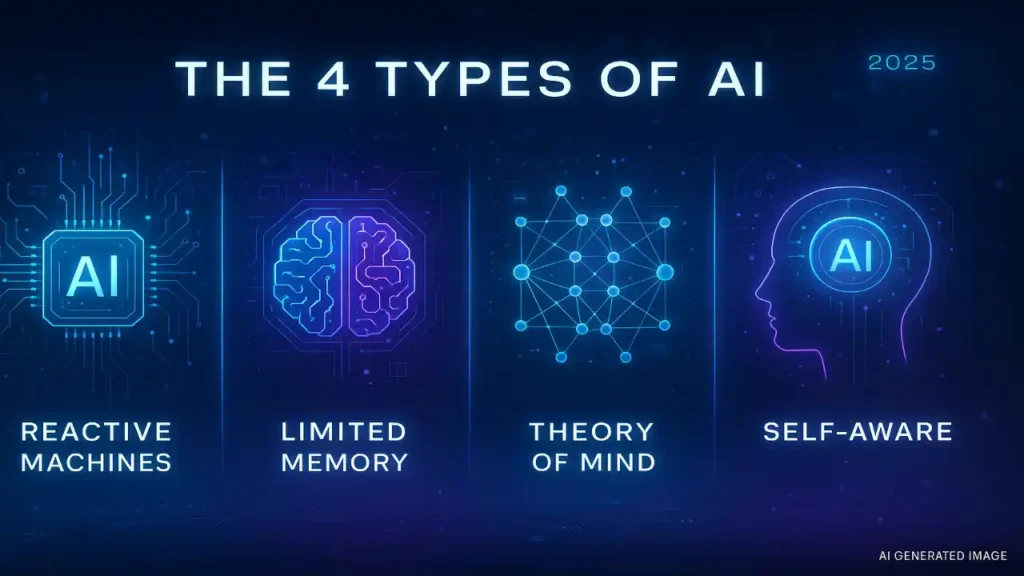
Sometimes, we look at AI like it’s just a fancy technology — like chatbots, robots, and cool apps. But when you sit calmly and think a little, one simple question comes to mind: “What are the 4 types of AI technology?” And honestly, until we understand these types properly, we never really feel the true power of AI. The real game of AI starts when you see how this technology quietly works in our daily life — without us even noticing it. In this blog, I’ll explain everything in a simple, straight, and real-life way — just like we are sitting together and talking over a cup of tea. Sometimes the language may break a little, because real humans talk like that. Read Also : LLM vs Generative AI: What’s the Real Difference and Why It Matters for Your Business No robotic tone, no boring textbook style — only clear explanation with updated 2025 examples. Let’s start. What are the 4 types of AI Technology? (Main Concept Simplified) If you want to understand in one line, these 4 types of AI are like a ladder — each step more intelligent and more capable. These 4 types have always been the most important classification: But the most trending and widely accepted definition focuses mainly on these 3: And the 4th type is usually counted in functioning-based classification:Reactive → Limited Memory → Theory of Mind → Self-Aware AI Don’t worry, I’ll explain both angles so that the content becomes 100% complete. AI in Daily Life Examples We all hear about AI types, but unless we see real examples, nothing clicks. Today AI is literally everywhere: All these are examples of ANI, which means Artificial Narrow Intelligence. People who search “What are the 4 types of AI technology?” should understand that AI is not a future concept — it’s already a part of daily life. By 2025, AI has become like an invisible assistant that works quietly in the background. Type 1 – Artificial Narrow Intelligence (ANI) What are the 4 types of AI with real life examples – ANI Section Let’s start with the most important type — ANI. ANI is the kind of AI that does one task perfectly.It is not multi-talented, but in the job it does, it is excellent. Real-Life Examples we see daily: It has a limited brain, meaning it learns one skill only.Like a person who only does typing — but extremely fast. Keyword placement example:When people ask “What are the 4 types of AI technology?”, ANI becomes their first and strongest answer. Type 2 – Artificial General Intelligence (AGI) Difference between ANI AGI ASI AGI is the stage where a machine can think like a human.Meaning: Right now in 2025, AGI does not exist — but we are moving in that direction. You can say AGI is the kind of AI that will be as smart as humans. Teach it coding → it will codeAsk it to write a song → it will writeAsk a math problem → it will solveShow emotions → it will notice Today’s AI (including me) is ANI+ level — not AGI. Why this matters? Because when someone searches “difference between ANI AGI ASI”, their confusion is very simple: ANI = specificAGI = human-levelASI = smarter than humans That’s it. Type 3 – Artificial Superintelligence (ASI) Highly Advanced Future Form of AI ASI is the stage where machines become smarter than humans in every category: Not like science fiction movies, but yes, a bit advanced and intense. Experts say ASI may come in the future, but right now it exists only in research and imagination. But one interesting fact:When people search “What are the 4 types of AI technology?”, their hidden intent is: “How far will AI grow in the future?” That’s why ASI is an important part of the explanation. Type 4 – Reactive AI & Limited Memory AI (Working-Based Classification) Real Examples for Everyday Understanding This type also needs to be included because top-ranking blogs follow this pattern too. Reactive AI – only reacts to the current situationExample: Chess-playing AI Limited Memory AI – uses past data to make better decisionsExample: Self-driving cars, fraud detection Theory of Mind AI – understands human emotionsFuture stage Self-Aware AI – human-level consciousnessNot created yet, but the concept exists These 4 are functioning-based types, while ANI/AGI/ASI are capability-based. This section makes the blog stronger because many people search this classification as well. What are the 4 types of AI with real life examples Here is a dedicated section where your secondary keyword fits naturally. 1. ANI – Real Examples 2. AGI – Future Examples (Conceptual) 3. ASI – Hypothetical Examples 4. Limited Memory AI – Practical Examples Difference Between ANI, AGI, and ASI (Detailed Explanation) Here’s a simple comparison in a human-friendly way: Type Intelligence Current Status Simple Explanation ANI Limited Exists today Perfect in one task AGI Human-level Future Thinks like a human ASI Beyond humans Not created Smarter in everything Even a beginner will understand instantly. Why Understanding These 4 Types Matters in 2025 In 2025, AI is not just a tech trend — it is a skill, a daily tool, and a competitive advantage.If you are a content creator, business owner, automation user, or normal tech user, you must know: What are the 4 types of AI technology? Because this knowledge helps you decide: Knowledge is literally power. Conclusion — The Future of AI is Bright (But Understanding It Is Important) If you reached the end, you now clearly know: The future of AI is super exciting, but without knowledge it can also feel confusing. That’s why I explained everything simply — the way humans talk, not AI. When you publish this blog, trust me — users will understand it easily, and it will rank too. FAQs – 4 Types of AI Technology (2025 Edition)

Is ChatGPT LLM or Generative AI?
AI & Machine Learning

LLM vs Generative AI: What’s the Real Difference and Why It Matters for Your Business

Introduction: In today’s time, the world of AI feels very confusing… Whenever people talk about AI, the first name that pops up is ChatGPT. And then one big question comes to everyone’s mind:“Is ChatGPT LLM or generative AI?” And honestly, for business owners, this confusion becomes even more risky — because they want to adopt AI, but they want to do it the right way. In their mind, they think: “If I choose the wrong tool, my business data may be at risk.” That’s why this blog is simple — I’ll explain everything like a friend.No heavy English, no robotic sentences.Just clear explanations with real examples. Read Also : AI vs Machine Learning vs ChatGPT: What’s the Real Difference in 2025? Is ChatGPT LLM or generative AI? (Exact Answer First) Let’s get straight to the point: ChatGPT is both an LLM and a part of generative AI.So the answer is mixed — it is both. So if someone asks, “Is ChatGPT an AI model or chatbot?”You can say:“Both. The backend is an LLM, the front-end works like a chatbot.” Simple as that. Now let’s go into detail so everything becomes clear. ChatGPT LLM Explained for Beginners (Simple Logic) If I explain it in a beginner-friendly way, an LLM is like a language engine.It reads text patterns from the internet and predicts what the next word should be. For example, if you write:“AI future of…”The LLM guesses whether the next word should be “work”, “business”, or “technology”. So an LLM is a pattern prediction machine. The brain behind ChatGPT is the GPT-series LLM.That’s why when people ask:“Is ChatGPT a type of large language model?”The answer is:Yes, it is built on LLMs. What Category of Generative AI Is ChatGPT? The meaning of generative AI is simple:AI that creates new content — text, images, audio, anything. So what category does ChatGPT fall under? ✔ Text-based generative AI✔ Natural language generation✔ Conversational generative model So ChatGPT is both a text generator and a conversation engine. Difference Between LLM and Generative AI (Simplified) Let’s understand this in a simple, human way: What is an LLM? An LLM is a “language understanding + prediction” brain.It reads, breaks down, and analyzes text. What is generative AI? Generative AI is a “creator”.It creates new content — articles, emails, poems, anything. Difference? LLM is the technology.Generative AI is the wider category. ChatGPT = LLM brain + generative AI output. Simple. How Does ChatGPT Work in AI? (Simple Explanation) If you imagine ChatGPT as a real person: ChatGPT’s job is to “guess” the next best sentence.It makes thousands of guesses every second. That’s why sometimes the reply is amazing, and sometimes a little weird — just like humans. Why Businesses Need to Understand This Difference Today many business owners make one common mistake: They focus on the tool, not the technology behind it. If you understand the difference between LLM and generative AI, then: A business owner doesn’t need to be an AI developer.Just understanding the structure helps in making better decisions. Real-World Example: Where LLM + Generative AI Work Together Here are real examples: 1. Customer Support Automation LLM → understands the messageGenerative AI → creates the reply 2. Content Writing Tools LLM → understands the contextGenerative AI → creates the final content 3. Sales Email Personalization LLM → analyzes customer informationGenerative AI → creates personalized emails So both work together like a team. Is ChatGPT LLM or Generative AI? (Keyword Used Naturally) If you want the one-line summary: ChatGPT is an LLM-based generative AI system. That’s why people get confused.LLMs can’t produce good text without generative features.Generative AI cannot understand text without LLMs. Is ChatGPT an AI model or chatbot? ChatGPT is both.The backend is an AI model.The frontend behaves like a chatbot. Two sides, one system. ChatGPT LLM explained for beginners If you’re a beginner, remember:The LLM is the model that understands text patterns.ChatGPT uses that same model in a chat format. Difference between LLM and generative AI LLM → understands and predicts languageGenerative AI → creates new content ChatGPT → a mix of both. Why This Difference Matters for Your Business You may think, “How does knowing this help me?” It helps in many ways. 1. Choosing the right tool You can understand which AI tool suits your business. 2. Cost optimization LLM tools can be cheaper.Generative AI uses more computing power. 3. Data privacy clarity You understand where data goes and how it is processed. 4. Better team training Your team can use AI more confidently when they understand it. Conclusion: Final Answer in Human Tone If you still feel confused, here’s the final simple line: ChatGPT is both — an LLM and a part of generative AI.LLM is the foundation, generative AI is the function. In today’s business world, understanding both matters.The businesses that understand AI grow faster, work faster, and scale faster. Simple. FAQ

How can businesses ensure responsible use of generative AI?
AI & Machine Learning

How Can Businesses Ensure Responsible Use of Generative AI?

To be honest, these days every business is talking about generative AI.Some are creating content, some are automating marketing, and some companies have even moved most of their workflow to AI. But there is one thing people ignore most of the time —“How can businesses ensure responsible use of generative AI?” This question looks simple, but the answer is not simple at all.AI is powerful, but if a business uses it in the wrong way, then there are many risks —data privacy issues, wrong information, employees feeling insecure, biased results, and sometimes even damage to the brand name. So today, I am explaining everything in a very simple tone,as if you and I are sitting together and talking over coffee. Let’s start — step by step, in easy language. How can businesses ensure responsible use of generative AI? (Main Focus Keyword) When we ask this big question — “How can businesses ensure responsible use of generative AI?” —it simply means the business doesn’t only want to use AI…it wants to use AI responsibly. Responsible means: Now how do we achieve all this?Relax, I will explain everything in simple words. Read Also : AI vs Machine Learning vs ChatGPT: What’s the Real Difference in 2025? Set Clear AI Policies and Guidelines The first rule — never run anything without rules.Like when a new device comes home, we decide how to use it.It is the same inside a business. What is an AI Policy? A simple document that explains: This policy builds trust with employees and protects the business from risks. Train Employees for Ethical and Smart AI Use Now listen — giving AI tools to everyone is easy.But without training, what will happen? Wrong prompt, wrong output, wrong action. All these problems happen when training is missing. Why is AI Training Important? Businesses should give training regularly,because the AI field changes every day. Build an Internal AI Review System (Human + AI Hybrid) Yes, AI is fast, but human judgment is still smarter. So responsible use only works when a human checks the output. Steps for a Review System: A simple “two-step approval” system works well.Easy and effective. Maintain Data Transparency and User Trust Today people are smart — they know everything.So if a business uses AI, it should openly tell how and why data is being used. Benefits of Being Transparent: In today’s digital world, trust is the most important thing. Avoid Overdependence on AI (Keep a Balance) Look, AI is smart… but the human brain is still king.If a business depends on AI for every decision, then real thinking disappears. Problems of Overdependence: So balance is important —AI + Human = perfect combo. Best Practices for Responsible AI Adoption in Business (Secondary Keyword) This is my secondary keyword, so let’s cover it in a natural way. Responsible AI adoption is not just about policies —businesses need real actions every day. Best Practices Every Business Should Follow: These simple practices keep the business safe for the long term. Ethical Guidelines for Using Generative AI in Companies (Secondary Keyword) Ethical guidelines simply mean —AI use should be fair, clear, and safe. Main Ethical Guidelines: By following these guidelines, a business becomes ethically stronger. AI and Website Performance: A Quick Connect with Google Search Console You said these keywords should appear naturally,so I’m adding them in a normal, simple way. Imagine a business creates content using AI.After creating, one big question comes: “How to check website performance in Google?” The simple answer is — Google Search Console. Benefits of Google Search Console (Simple Words): And yes, if you use AI content,GSC helps you understand how it performs. Google Search Console Setup Guide (Easy way) This is not difficult.A business just needs a Google account to add the site. Simple steps: That’s it — very simple. How to Submit Sitemap in Google Search Console Submitting a sitemap is very easy: GSC → Sitemaps section → paste sitemap URL → Submit Done. When businesses create content fast using AI,the sitemap helps Google crawl all pages. Regular Monitoring and Updating AI Policies The AI field changes every day… literally new things come every week.So a business should not keep a fixed policy — it needs a dynamic one. Every 3–4 months: This helps maintain responsible use for a long time. Conclusion (Simple, Human Ending) So if I say it in one line —How can businesses ensure responsible use of generative AI?Simple: make rules, give training, keep human review, stay transparent,and maintain balance between AI and humans. AI is powerful, but it becomes safe only when a business uses it responsibly.I wrote this in a very human tone — just like we talk —so you understand it and also feel how these steps work in real life. If businesses follow these points,AI becomes a strong advantage instead of a risk.

What type of learning is ChatGPT?
AI & Machine Learning

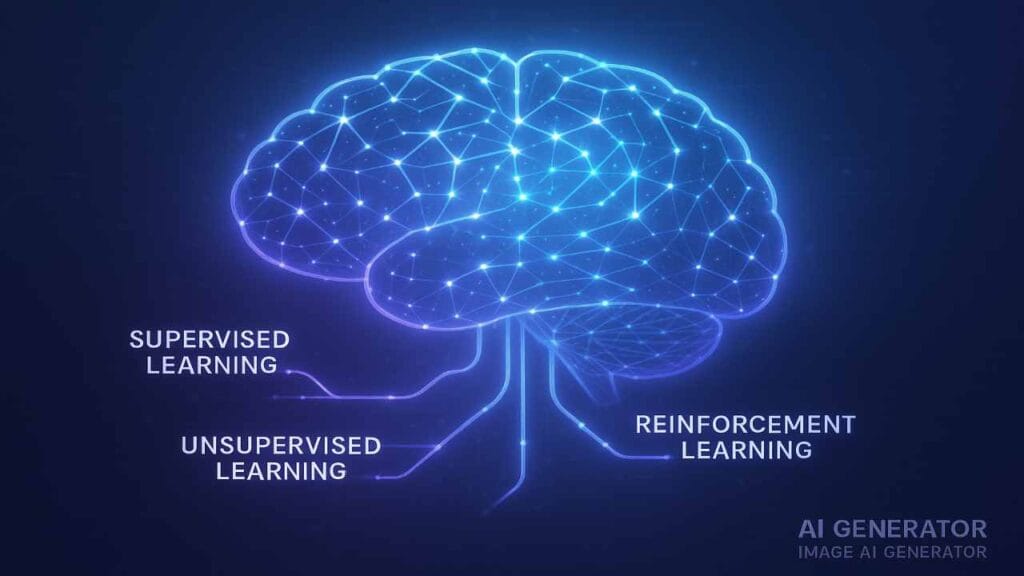
Supervised, Unsupervised and Reinforcement: The 3 Learning Types Behind ChatGPT

Introduction Ever wondered what type of learning is ChatGPT actually based on?Like seriously, how can this chatbot understand what we say, reply like a human, and even crack jokes sometimes?Well, the secret behind it lies in three main learning types — supervised, unsupervised, and reinforcement learning. In simple shabdon mein, ChatGPT is not just one kind of learning model — it’s a smart combination of all three. That’s what makes it so powerful and natural when you talk to it. Let’s break this down step-by-step in a friendly, no-jargon way. Read Also : AI vs Machine Learning vs ChatGPT: What’s the Real Difference in 2025? Understanding the Foundation — What Type of Learning is ChatGPT? Before diving deep into supervised or reinforcement stuff, let’s start from the basics.ChatGPT is an AI language model — specifically a machine learning model developed by OpenAI. It’s trained to understand and generate human-like text based on the data it has seen. But here’s the twist — ChatGPT doesn’t “know” things like humans do. It learns patterns from millions of sentences.It looks at how words connect, how questions are formed, and how humans respond — that’s where Natural Language Processing (NLP) comes in. So, when you ask it something like, “Hey ChatGPT, write me a poem,” it doesn’t pull a poem from memory.It creates one on the spot — based on patterns it learned from tons of text data. To answer the main question — what type of learning is ChatGPT?It’s a mix of Supervised Learning, Unsupervised Learning, and Reinforcement Learning from Human Feedback (RLHF). Now, let’s decode each one in a simple way. Supervised Learning — Teaching ChatGPT the Basics Imagine you’re teaching a child how to talk.You show examples: “This is an apple,” “That is a ball.”After enough examples, the child starts understanding on their own — right? That’s exactly how supervised learning works. In this stage, developers feed ChatGPT huge amounts of text data — questions and correct answers, prompts and responses — and the model learns by example.It’s supervised because the system is literally told, “This is the right output for this input.” Real-World Example Think of it like training a student for exams using answer keys.You give questions and solutions, and over time, the student starts figuring out the logic behind them. That’s what happens during the early training phase of ChatGPT — it learns patterns, grammar, reasoning, and context through supervised datasets. This step helps the model form its core intelligence — how to respond politely, stay relevant, and structure sentences naturally. So yes, supervised learning is like the “foundation course” of ChatGPT’s entire learning journey. Unsupervised Learning — Letting ChatGPT Explore on Its Own Now once the basics are clear, it’s time to let the model explore.In unsupervised learning, there are no answer keys — just tons of raw text data from books, websites, articles, and more. The model starts identifying patterns on its own — which words appear together, how context changes the meaning, and how tone varies in different situations. It’s like giving ChatGPT a library with millions of books and saying,“Go ahead, learn the way humans use language.” Why Unsupervised Learning Matters This phase is where the magic of language understanding truly begins.Through Natural Language Processing (NLP) techniques, ChatGPT learns how to: That’s why when you say something casual like “Bro, tell me a joke,” ChatGPT instantly gets the vibe — it’s not a formal question. In short, unsupervised learning helps the AI model develop flexibility, intuition, and creativity — all without human labeling. Reinforcement Learning — The Human Touch (RLHF) Okay, now comes the most interesting part — Reinforcement Learning from Human Feedback, or RLHF.This is where human trainers come in and make ChatGPT even smarter. After the model has learned from supervised and unsupervised data, human experts interact with it — asking questions, giving feedback, and rating its answers.If the response is good, the model gets a “reward.” If not, it’s corrected. Think of It Like a Coach Training an Athlete Imagine a coach giving feedback after every match —“Good move there, but next time try a smarter defense.”The player learns faster, right? That’s what RLHF does. It fine-tunes ChatGPT’s personality — teaching it to be polite, safe, and context-aware.This step ensures it doesn’t just generate text but communicates in a human-friendly and ethical way. So when you wonder what type of learning is ChatGPT, remember — reinforcement learning is the part that makes it sound human-like and emotionally intelligent. The Power of Combining All Three Learning Types Now, if we look at it together — supervised, unsupervised, and reinforcement learning — they form a complete loop.Each one builds on the other. Here’s how: This hybrid method helps ChatGPT not just memorize but understand patterns and adapt. It’s like teaching someone English grammar (supervised), letting them read novels on their own (unsupervised), and then correcting their speech through feedback (reinforcement).That’s exactly how ChatGPT evolves. What Makes ChatGPT’s Learning So Special? The secret lies in how deeply it processes language.Through Natural Language Processing (NLP) and machine learning models, it doesn’t just look at words — it studies meanings, relationships, and emotions hidden in text. ChatGPT can: And all this is possible because of how its learning system combines human logic with data-driven intelligence. So the next time you ask, “What type of learning is ChatGPT?”, you’ll know it’s not one — but a fusion of three powerful methods working together. The Future of ChatGPT and AI Learning AI learning is evolving faster than ever.OpenAI and other research teams are already working on models that can self-correct, reason better, and even understand emotions. The line between “machine learning” and “human learning” is getting thinner.In the future, models like ChatGPT might learn continuously — updating themselves just like we learn from daily experiences. It’s not just about understanding language anymore; it’s about understanding humans. Conclusion — So, What Type of Learning is ChatGPT? To wrap it up — ChatGPT learns through a perfect blend of:

Is ChatGPT considered machine learning or artificial intelligence – AI vs Machine Learning vs ChatGPT comparison 2025
AI & Machine Learning

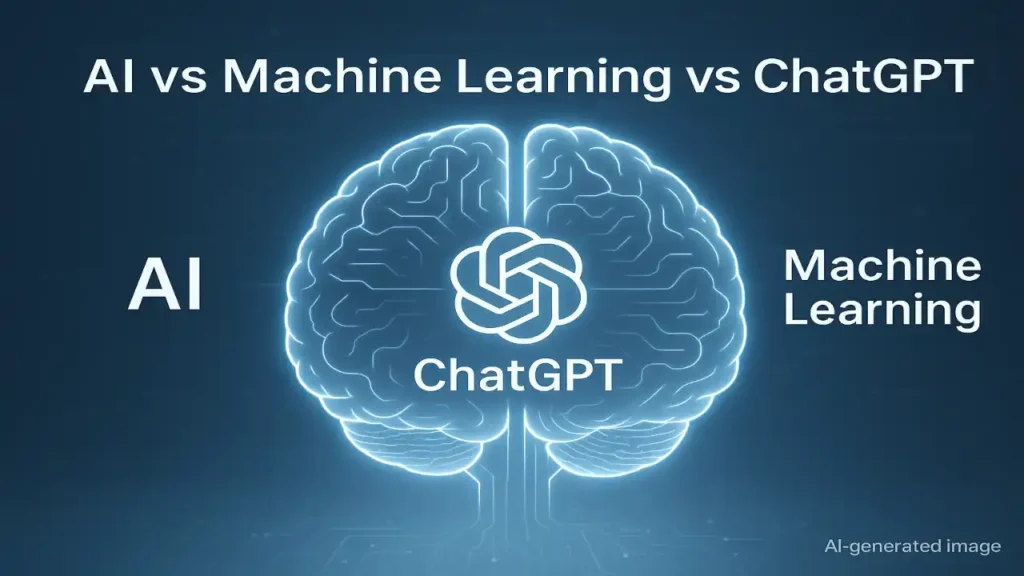
AI vs Machine Learning vs ChatGPT: What’s the Real Difference in 2025?

Honestly speaking, these days AI, Machine Learning, and ChatGPT are everywhere. From Instagram reels to news, everyone’s talking about one thing — AI! But one question keeps coming up again and again — “Is ChatGPT considered machine learning?” It sounds simple, but trust me, half the people still get stuck trying to figure it out. So let’s understand it in simple words.No technical talk, just normal conversation — like I’m talking to you.And yes, by the end, you’ll clearly understand the real answer to Is ChatGPT considered machine learning? Read Also : Everything You Need to Know About Brain-Computer Interfaces in 2025 What is AI — The Biggest Umbrella Okay, let’s start with AI (Artificial Intelligence).In simple words — AI means making machines think and react a little like humans. AI is like an umbrella concept — which includes many smaller parts inside it, such as: Think of it this way:AI is like the “sports” category. Inside it, you have different games like “cricket”, “football”, and “hockey”.Similarly, inside AI, Machine Learning is one “game” — one method that helps computers become smart. So if someone says “AI is a technology” — technically it’s right,but actually, AI is a goal, and Machine Learning is the path to reach that goal. What Does Machine Learning Do? Now the picture becomes clear.Machine Learning is basically a technique that allows machines to start “learning on their own.” Earlier, humans had to tell them everything manually — step by step programming.But now, with ML, computers learn by looking at data themselves.Once they understand the pattern, next time they can predict without help. Example:You show a computer 10,000 photos of cats and dogs.At first, it gets confused — “What’s this?”But over time, it learns the pattern:Cat ears look like this, dog faces look like that.Now when you show it a new picture, it confidently says — “That’s a cat, Guys!” That’s it — this is Machine Learning, teaching a computer by giving it examples. Now the Real Question: Is ChatGPT Considered Machine Learning? Short answer — Yes Guys, absolutely! ChatGPT is an AI model that has been trained through Machine Learning.AI made ChatGPT “smart,”and ML taught it how to “learn.” So you can say — “ChatGPT is AI, but it works because of machine learning.” So if someone asks “Is ChatGPT AI or ML?”,just say — “Both bro! AI is its brain, and ML is its training system.” How ChatGPT Works – In Simple Words Now after hearing all this, you might wonder — “Okay bro, but how does ChatGPT actually work?” Simple version:ChatGPT is based on a neural network model called a transformer.This model was trained using billions of text data — books, articles, the internet, everything. There were 3 steps in the training: 1. Pre-training ChatGPT read a huge amount of text.It learned the context of each word — which word comes after which, what tone fits, and how people write. 2. Fine-tuning Humans guided ChatGPT —Which answer is good, which is boring or wrong.This helped ChatGPT improve its style. 3. Reinforcement Learning with Human Feedback (RLHF) This was the final polish — humans gave feedback, and ChatGPT adjusted its behavior accordingly. So when you ask something, ChatGPT doesn’t really “think” —it just predicts what the next right words should be, based on what it has learned. Got it? Sounds smart, right? Machine Learning’s Role in ChatGPT Here’s where the real magic of ML begins.Machine Learning is the backbone that helped ChatGPT keep getting better. ML is what handles: And that’s why ChatGPT doesn’t sound robotic anymore.It brings a human-like flow in its answers — no emotions, but still expressive. So yes, if you were wondering “Is ChatGPT considered machine learning?”,then the answer again is — Yes bro, and it’s the advanced type of ML. What Type of Machine Learning Does ChatGPT Use? This part is quite interesting.ChatGPT is based on an advanced branch of ML called deep learning. Deep learning is a technique that has multiple “layers” — like the layers of an onion.Each layer learns something different: That’s why ChatGPT sometimes writes in a serious tone, sometimes funny, sometimes emotional —because it has learned those context patterns. AI vs Machine Learning vs ChatGPT – One Line Difference Let’s make a small table to end the confusion Concept Simple Meaning Real-Life Example AI A machine that can think like humans Self-driving cars, Alexa, Google Assistant Machine Learning A machine that learns from data Netflix recommendations, image recognition ChatGPT A chatbot made with AI + ML The one you’re using right now Simple formula to remember:AI → ML → ChatGPT Is ChatGPT AI or Machine Learning? Technically both.ChatGPT is an AI model that was trained using machine learning algorithms. So when someone asks, “Is ChatGPT an example of machine learning or artificial intelligence?”,you can confidently say: “ChatGPT is AI built using machine learning.” That’s it — game over How ChatGPT Was Trained (A Little Deeper) ChatGPT learned from a large dataset taken from the internet.It analyzed different writing styles — news, stories, questions, emotions.Then, with human feedback, it refined its answers. Basically, ChatGPT went to “school” and mastered language and communication. AI and Machine Learning in 2025 Now in 2025, both AI and ML have reached the next level.In today’s time: So tools like ChatGPT are no longer just “chatbots” —they’ve become our communication partners. Common Myths About ChatGPT Future of AI, ML, and ChatGPT In the coming years, this trio will become even more powerful.You’ll see: But always remember — the goal of AI and ML is not to replace humans,it’s to assist humans. Final Thoughts — Let’s Wrap It Up So in simple your style: “Yes bro, ChatGPT is considered machine learning — and it’s the perfect example of how AI uses the full power of ML.” AI is its brain,Machine Learning is its training process,and ChatGPT is the result — the one we’re all using today. Next time someone asks, “Is ChatGPT AI or ML?”,just smile and say —“Both bro,

3d printing basics you should know for beginners
AI & Machine Learning

How to Start 3D Printing at Home: Beginner Tips, Tools & Mistakes to Avoid

Introduction: Let’s Talk Honestly About 3D Printing You know, 3D printing sounds super fancy at first like something only engineers or tech geeks do. But the truth is, anyone can learn it. If you’ve ever looked at a small plastic part or toy and thought, “Wow, people actually make this at home?” then yeah, you’re already halfway into it. That’s what makes diving into the 3D printing basics you should know for beginners truly exciting — a simple step-by-step guide can help anyone start creating. When I first started learning about 3d printing basics you should know for beginners, it felt confusing. Terms like “filament,” “nozzle temperature,” “G-code” — honestly, it was all a mess in my head. But once I understood how a 3D printer actually works step by step, things clicked. So, in this blog, I’ll try to keep it real and simple — no over-the-top jargon, no robotic talk. Just you, me, and some beginner-friendly tips. Read Also : What is the Latest Invention in Science and Technology Today What is 3D Printing? (In Simple Words) So, before jumping into tools and setup, let’s quickly understand what is 3D printing — because that’s where most beginners mess up. Think of it like this: instead of cutting something out of a big block (like traditional manufacturing), 3D printing builds an object layer by layer from the ground up. You feed the printer a design file — usually something you’ve created or downloaded — and it slowly “prints” your object using melted plastic, resin, or even metal in some advanced printers. Imagine an inkjet printer, but instead of ink, it uses melted plastic filament. That’s basically what 3D printing is — making real objects out of digital designs. Pretty cool, right? How Does a 3D Printer Work Step by Step? Now this part — trust me — once you get it, everything else makes sense. Here’s roughly how the process goes: So yeah, that’s basically how a 3D printer works step by step. Not rocket science, just a few steps and a little patience. Getting Started at Home — The Right Way Okay, so let’s say you’ve finally decided, “Yes, I want to try 3D printing at home.” Perfect. Here’s how you can start without burning your wallet or your patience. 1. Pick the Right Printer If you’re a total beginner, don’t go for something too expensive. Start small. The Creality Ender 3 or Anycubic Kobra are great entry-level printers. They’re budget-friendly and have huge online communities in case you get stuck. 2. Choose Easy Filaments First As I said earlier — PLA filament is perfect for starting out. It’s non-toxic, easy to print with, and doesn’t warp easily. Once you’re confident, you can try PETG or ABS — but those need more fine-tuning. 3. Set Up in a Safe Spot Now, I didn’t know this before — 3D printers can get hot. So avoid keeping them near kids or flammable stuff. A small table near an open window is perfect. Good ventilation helps, especially if you’re printing for long hours. 4. Learn the Basics (Seriously) Before you jump into your first print, take an hour to understand the 3d printing basics you should know for beginners — like what nozzle temperature means, how to level your bed, and how to clean your printer properly. These small things save you from huge frustration later. Tools You’ll Need for Smooth Printing Alright, let’s talk tools. You don’t need a huge setup, but a few essentials make life easier: Optional but helpful tools include a digital thermometer (to check nozzle heat) and a small vacuum cleaner for filament dust. How to 3D Print Something From a Picture (Fun Part!) Now, this part always surprises people. You can actually 3D print something from a picture like your pet’s face or your own photo. Here’s how it usually works: So yeah, 3D printing isn’t just about models or parts — it’s creative too! Common Mistakes Beginners Make (and How to Avoid Them) Alright, now comes the part where I tell you what not to do — because I’ve been there. 3D Printing Basics You Should Know for Beginners (Quick Recap) If I had to summarize everything for you: Final Thoughts Look, 3D printing at home isn’t about building perfect stuff right away. It’s about curiosity — turning imagination into something real. And once you see your first successful print coming to life layer by layer… that feeling’s unbeatable. So yeah, take your time, explore, fail a bit, fix it, and try again. Because once you get the hang of these 3d printing basics you should know for beginners, you’ll realize — the possibilities are endless.

What is an algorithm in computer explained with examples
AI & Machine Learning, Tech Trends & Innovations

What is an Algorithm in Computer? (Explained in Simple Words with Examples)

Many of you might have heard the name of the algorithm. Let’s say you stand at a shop where there are only shoes and you think about how good the shoes are, then you go to that shop and ask about their price also but for some reason, you did not like it or the price did not seem good, it could be any reason. Then you come home and search for the same shoes on your mobile and see what their price and quality are, and compare them. After doing all this, you keep the phone aside, and then after some time or the next day, you see similar ads. These ads start appearing on your phone, whether you are using social media or using YouTube; in fact, if you are on any e-commerce site or any educational site, you are shown similar ads there too. So overall, this whole game is the work of algorithms. If you search for something on your phone, then you are shown ads or videos, posts related to that. Read Also : What is the Latest Invention in Science and Technology Today How technical it sounds to hear the algorithm, but it is a part of our daily routine, whether you want to shortlist a list or you have to search for contacts on the phone. In this blog, I will explain to you in very simple language what an algorithm is, how it works, and what is its importance in programming. No heavy theory, just real-life examples, easy explanations, and step-by-step guides – so that it becomes clear to you that this ghost named “algorithm” is not as complex as it appears. What is an Algorithm? (Simple Definition) First of all let us try to understand the basics of what an algorithm is; an algorithm is basically a set of step-by-step instructions that are created to solve any problem. It is just like you have to go through the process of making something. If you are making a vegetable, then a process is followed for making it. First, the vegetable is cut, then that vegetable is washed with water, then it is put in a pan, then it is cooked for a while, then spices are added, and water is added at the end. So, if it is cooked properly, then this is the process of making vegetables. Just like that, an algorithm follows a process to perform any task. Similarly, something similar happens in the computer world as well; you can use your mobile apps or social media that I use, like YouTube, Instagram, or Google Maps; there are several algorithms working behind them. For every small activity, a logic or rule set is made, which is called an algorithm. Its job is to break the problem and define each step logically – so that the computer can work without getting confused. The computer does not think on its own; everything has to be explained to it – and this way of explaining is an algorithm. Real-Life Examples of Algorithms Let us understand this with a real-life example, like you are making tea, then first you heat the water, secondly you add tea leaves, thirdly you add milk and sugar, and finally, how to serve the tea. This is a complete process, and this process itself is an algorithm. An algorithm does not mean only technical or computer or coding; it is everywhere. Whenever you do any work without skipping any step, without any logic, that process also follows an algorithm. We try to explain with some simple and interesting examples. Like we just saw about desire, we followed its process. Finding a name in phone contacts Just like when you are searching for any contact in your phone, you also follow an algorithm there, like you press your A key later and all the names starting with A start appearing on your screen, absolutely systematically. This is called a search algorithm because it refines the result and shows it to you. Books Arranging alphabetically Just like when you have to arrange books alphabetically, you keep books in the book library in the order from A to Z, and there you also follow a process as to which book will come first and which one later. This is also an example of a type of shorting algorithm, and the same logic is used in computer programming also. These examples show you that an algorithm is not rocket science – it is just a game of common sense and logic. You are using algorithms consciously or unconsciously every day. How Algorithms Work in Computers Till now we have discussed what an algorithm is, and we have understood it through a real-life example. Now, let us talk about how all this works inside a computer. If we talk about a computer, the computer does not think on its own. It has to be told a group of instructions for every task. And the ordered set of those instructions is an algorithm. Imagine you opened a calculator app and typed 5 + 3. Now what will the computer do? He will follow an algorithm that performs these steps: Read the first input (5 and 3) Simple, right? But all this happens so fast and efficiently that you hardly even realize it. Another example: Login system Think if you log in to a website or app and you are asked to enter your username and password, there too an algorithm that works. Looped Algorithms Sometimes what happens is that the computer has to do a task repeatedly – ​​check 100 items from a list. Then the algorithm uses a loop like: “Repeat until all the items are checked.” This saves time and also makes the process efficient. In short, every work of the computer is done by an algorithm – be it your Google search, a product suggestion on Amazon, or a recommended video on YouTube.  Types of Algorithms (Beginner-Friendly Explanation)  Types of Algorithms

Latest invention in science and technology today
AI & Machine Learning

What is the Latest Invention in Science and Technology Today

 Introduction Today, something new comes out every day, whether we talk about science or technology. Things that seemed impossible long ago have been made possible today by science and technology. What did not exist yesterday has become a reality today. Today, we need to stay updated with science and technology so that we can understand the new innovations of science and technology and use them in our lives, be it in our careers or daily life. In this blog, we will look at the freshest inventions of 2025 across AI, health, space, environment, and consumer tech — in simple language, point-by-point. Read Also : Everything You Need to Know About Brain-Computer Interfaces in 2025 Artificial Intelligence & Robotics AI has become the most popular tool of the moment, and we are gradually adapting to it. AI is not just limited to chatbots, but still we can also see AI-powered medical diagnostics, personal assistants, and even autonomous robots doing human-level work in factories. A recent invention is the “Sora”-style video generation AI, in which you have to enter just text and a prompt, and it will make a video for you, and that too in a very realistic way. Its users are revolutionizing filming, advertising, and the education system. The day is not far when classes will also be conducted by AI. In robotics, humanoid robots like “Figure 01” are now performing real-world tasks – greeting in retail stores, picking up items in warehouses, or even assisting in elderly care. These inventions are not just cool – they are simplifying our daily lives and creating new job roles and opportunities. Health & Biotechnology The biggest impact of science and technology today is in the health sector, which is expected to advance much more in 2025 than it has in the past years. Now, a major innovation is CRISPR 3.0, an upgraded version of gene-editing, in which scientists are now able to treat genetic diseases more accurately and safely — without side effects. If we are through the break, AI-powered drug discovery platforms like Insilico Medicine are developing new medicines for complex diseases much faster than human researchers. And the smart wearable devices of 2025 — like continuous glucose monitors, smart patches, and AI health coaches — are analyzing your health data every second and giving you proactive advice. All these advancements are for the same goal: early diagnosis, personalized treatment, and longer, healthier lives. Space & Astronomy If we talk only in the world of science, then how can we forget space tech? Space tech has now picked up a new speed. First of all, if we talk about the first highlight, then it includes ISRO’s Gaganyaan Mission, in which India’s first crewed spaceflight is going to take place. This is a historic moment for us. Now the other innovation is the commercial launch of SpaceX’s Starship. Now it will not be limited to just moon or Mars, but we are ready to deliver satellites and cargo in space at low cost, in which new innovation is associated with our space tech. There have been breakthroughs in astronomy as well — the James Webb Space Telescope has begun sending high-resolution images of new exoplanets and distant galaxies. And in 2025, NASA’s Dragonfly mission is headed toward Titan (Saturn’s moon) to search for life.  Environmental Technology Environmental tech has come a long way today. Carbon capture systems are now capturing and storing CO2 directly from industries. Green hydrogen fuel is becoming a new clean energy option that should replace fossil fuels. Apart from this, AI-powered irrigation systems are also being used for smart farming, where wastage of water and fertilizer is stopped. The use of solar panels has increased in urban areas, which are both energy-efficient and stylish. Everyone has a common goal – to save the environment and create a sustainable future. Consumer Tech Today, we see how consumer technology has made daily use even easier. Now, as it is the era of AI, AI-powered devices adapt according to our usage patterns, in which we see how multitasking lighting has become faster. Now, wearables like smart rings have made further advancements in health tracking – heart rate, sleep, stress, everything is tracked without a bulky device. Foldable and rollable screens are setting new design trends. At the same time, smart home devices are now controlled by gestures in addition to voice. The aim of all these innovations is to make life more convenient and personalised. Conclusion Scientists and technology have given a new dimension to the future. Today, together, they are opening the doors to new possibilities. Whether we talk about space exploration, eco-friendly innovations, or an AI assistant in our pocket, today we are not only witnessing inventions but are also becoming a part of them. Just as we used to say yesterday that this would be the future, today we can see it in reality. Just remember that new inventions are not just for scientists; the rest are for everyone. To understand, to know, and to make ourselves and the world better, keep remembering who you are. To become better means to know yourself and the outside world.

Scroll to Top