convertfilepro.com

Career

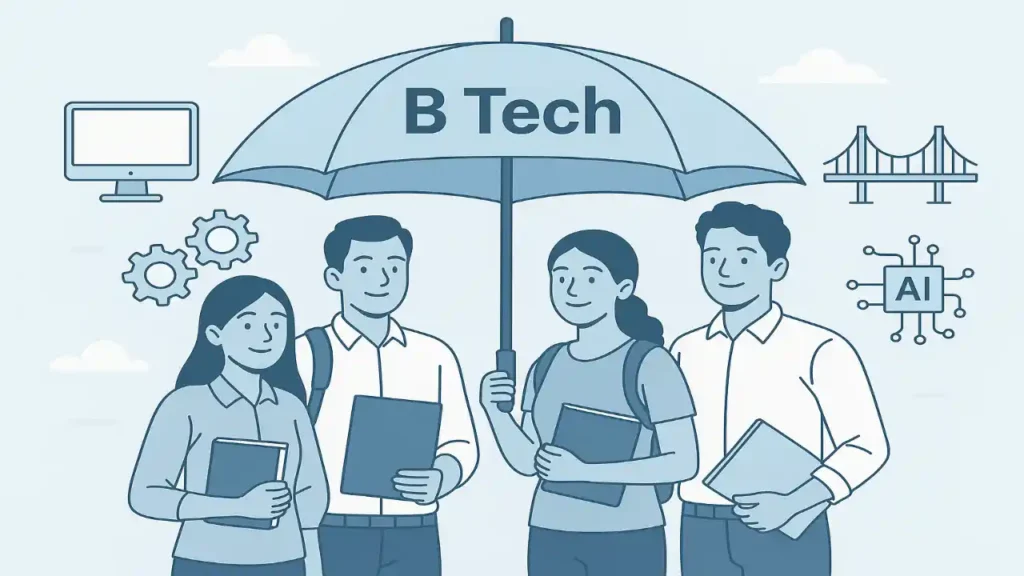
Visual representation of BTech courses and engineering branches in India.
Career

How Many Courses Are There in BTech? Complete Branch-Wise Breakdown (2025 Guide)

Choosing BTech is exciting, but let’s be honest — it can also feel confusing.One simple question keeps coming to everyone’s mind at the start: How many courses are there in BTech? You hear different answers from different people.Some say “bahut saare hote hain,” some say “sirf core branches hoti hain,” and Google? It throws long lists without clear explanation. So in this blog, I’ll explain everything slowly, clearly, and in a human way — just like I’d explain it to a friend who’s genuinely trying to understand BTech before taking a big life decision. No hype.No promotion.Just real clarity. Read Also : How to Choose the Best AI Course for Project Management What Is BTech and Why Branches Matter BTech, or Bachelor of Technology, is a 4-year undergraduate engineering degree.But BTech is not one single course. It’s more like a main umbrella, and under it, there are many different branches. Each branch focuses on a specific area of engineering, like computers, machines, electricity, construction, or even space. That’s why asking how many courses are there in BTech is actually the right question — because your branch decides: So, How Many Courses Are There in BTech in 2025? Let’s answer this directly. In India, there are around 30 to 40 BTech courses (branches) offered across universities and engineering colleges. Now, don’t get stuck on the exact number.Why? Because: But yes, on average, when students ask how many courses are there in BTech, the realistic answer is: Around 30+ different BTech branches, including core, specialized, and new-age engineering fields. Now let’s break this down properly. Types of BTech Courses (Big Picture Overview) Before jumping into a long BTech branches list, it’s important to understand the types of BTech courses. Broadly, BTech courses fall into three main categories: This classification makes everything much easier to understand. Core Engineering Branches in BTech These are the traditional and most popular branches.Almost every engineering college in India offers these. List of Core BTech Courses Some major core branches include: These branches form the foundation of engineering education. If someone asks how many branches in BTech engineering are core, the answer is usually 8–10 main branches. They’ve been around for decades and still hold strong value. Why Core Branches Still Matter Even in 2025, core branches are not outdated.They simply require skill-based learning instead of rote study. For example: So yes, core branches are still very relevant. Specialized BTech Branches (Modern Focus) Now comes the interesting part. As technology evolved, universities started offering specialized BTech courses focusing on specific industries. These are not separate degrees — they are BTech degrees with focused specializations. BTech Branches List – Specialized Courses Here are some popular specialized BTech branches: These branches exist because industries demand job-ready skills, not just theory. How These Affect the Count of BTech Courses This is where confusion usually happens. Someone counts only core branches and says: “There are only 10 BTech courses.” Another person counts all specializations and says: “There are more than 40!” Both are partially correct. That’s why, when asked how many courses are there in BTech, the most accurate answer includes both core and specialized branches. Emerging & New-Age BTech Courses (2025 and Beyond) This is the fastest-growing category. Many universities are now offering future-focused BTech branches aligned with new technologies. Examples of Emerging BTech Courses These branches may not be available everywhere, but their number is growing every year. So naturally, the question how many courses are there in BTech keeps evolving with time. Complete BTech Branches List (Consolidated View) To make things simple, here’s a combined BTech branches list covering all categories. Major BTech Branches You’ll Commonly Find This list itself shows how many branches in BTech engineering exist when we consider everything together. Why There Is No “Fixed” Number of BTech Courses This is important to understand. There is no single official number because: So instead of asking for an exact number, it’s better to understand: Still, from an SEO and student perspective, 30–40 BTech courses is a fair and practical range. How to Choose the Right BTech Course for Yourself Now that you know how many courses are there in BTech, the next question becomes more personal. Ask yourself: There’s no “best” branch.There’s only the right branch for you. Final Thoughts If you reached till here, one thing should be clear now. When someone asks how many courses are there in BTech, the real answer is not just a number — it’s an understanding. BTech is a wide field with: Instead of getting overwhelmed by the BTech branches list, focus on what aligns with your interest and mindset. Engineering is not about choosing the “most popular” branch.It’s about choosing the branch where you can grow, learn, and stay curious. And honestly, once that clarity comes, half the confusion disappears on its own. Frequently Asked Questions (FAQs)


Futuristic smart classroom showing a student surrounded by glowing holograms, AI learning icons, digital screens, and VR-style education elements with warm and cool neon lighting.
AI & Machine Learning, Career

How AI Helps in Education: Real Examples, Practical Tools & The Future of Learning

Introduction Have you ever noticed how fast the education system has changed in the last few years? Earlier classrooms were limited to blackboards, and now… AI is literally everywhere. And honestly, when people ask “how ai helps in education?”, I feel it is important to explain this topic in simple words. Today’s student is not the same anymore. Their learning style has changed. Their expectations have changed. And teachers are also adapting with technology. AI works like a bridge between all of this — a tool that makes learning more personal, makes teaching easier, and makes education smarter overall.Let’s look at this topic from a very practical angle: The tone will be simple, like I am sitting and talking to you. Let’s start. Read Also : How Does AI Technology Work? Simple Guide for 2025 How AI Helps in Education If I say it in simple words, the main work of AI in education is to make learning smart, personalized, and efficient. Earlier, teachers needed time to understand the pace of each student. Now AI automatically analyzes and shows where a student is struggling. This kind of smart analysis was not possible earlier. And this is where AI shows its real power. 1. Personalized Learning for Every Student Today, the biggest advantage is this — the benefits of AI in learning are not limited to theory.AI tracks every student’s: And then suggests study material based on that. If you think about it, it’s difficult for a teacher to guide 40 students individually… but AI makes this easy. Example:If a student is slow in math, AI gives extra practice. But if another student is doing well, the AI increases the difficulty level. This is real personalization — something that wasn’t this smooth before. 2. Instant Feedback & Better Assessments Teachers like this point the most.AI systems instantly show whether a student’s answer is right or wrong, or if their approach is incorrect. Because of this: And yes, AI never gets tired — so there are fewer checking mistakes. 3. AI-Powered Teaching Solutions This might sound technical, but it is quite simple.Today, AI works like an assistant for teachers. AI-powered teaching solutions help with: You can say AI reduces half of the teacher’s workload.And when workload reduces, teachers can focus on actual teaching — which is the main goal. 4. Smart Classrooms & Interactive Learning A smart classroom doesn’t mean just installing screens.A smart classroom means making learning engaging. With AI, students can: And honestly, when students get engaged, their concept understanding becomes much stronger. Imagine a tough physics topic… AI shows it in a 3D animation. It becomes so easy! Real Classroom Examples of How AI Helps in Education This part is very important because real examples help people understand better.Let’s see some practical examples used in schools and colleges. Example 1: AI Homework Helper Earlier students had to wait until next day’s class.Now AI apps explain their doubts instantly — step-by-step. Teachers also like this because students come prepared. Example 2: AI Reading Assistants For young students, AI helps a lot in improving reading.AI listens to their pronunciation, highlights mistakes, and gives real-time feedback. It becomes a very natural learning process. Example 3: Smart Essay Checker In colleges, AI tools check grammar, structure, and clarity.They suggest improvements and guide students to write better. Without giving extra work to teachers, students still improve. Example 4: AI Data Insights for Teachers Teachers get clear reports showing which student is weak in which area.These kinds of insights were almost impossible with manual checking. This makes teaching more strategic. Example 5: Virtual AI Tutors Students can learn a topic again and again through AI tutors.AI does not get angry, AI does not get bored…Students can revise as many times as they want. AI Tools for Students Let’s talk practically.Which AI tools for students are actually useful? These tools help students with: Common tools used by students: All of these have one simple goal — making learning easier and reducing stress. Role of Artificial Intelligence in Education If we look broadly, the role of artificial intelligence in education has three main areas: AI is not replacing teachers.It is only reducing their workload so classrooms can function better. And honestly, the whole system becomes smarter automatically. Benefits of AI in Learning Let’s keep this simple: 1. Learning becomes fasterStudents understand concepts more quickly. 2. Learning becomes personalEvery student gets what they need individually. 3. Students become confidentInstant feedback increases motivation. 4. Teachers get more timeLess admin work, more teaching. 5. Learning becomes funInteractive tools make subjects more enjoyable. Future of Learning with AI Now let’s look a little into the future.In the coming years, the education system will become even more advanced — and AI will be its main support. Future trends you will see: Honestly, in the next 10 years, learning will look so different that today’s system will feel outdated. Conclusion If I say it simply, the answer to how ai helps in education is this —AI makes learning smarter, more personal, and more accessible. Teachers get support, students get clarity, and the education system becomes better. In the future, AI will be even more deeply connected to education.And as long as it is used in a balanced and ethical way, it will always be a helpful part of the system. FAQs

Students in a classroom discussing MBA courses, specializations, and electives in a modern business setting.
Career

How Many Courses Are There in an MBA? A Complete Guide to Core, Elective, and Specialization Subjects (2025)

Everyone says MBA is perfect for a career, but when it comes to courses, it can be a bit confusing. Core courses, electives, specializations — all together make an MBA program structure look complex. Today, I will tell you step by step which courses are there in an MBA, how they are distributed semester-wise, and how you can choose the best for your career. This guide will also help you understand MBA full-time vs part-time courses, MBA online courses, and MBA subject list with credits. Read Also : How Many Types of Engineering Courses Are There in 2025? Complete Guide for Students MBA Curriculum Structure: Important to Understand First, let’s understand what an MBA curriculum structure is. In simple words, the MBA is designed to give you a business foundation and also let you develop expertise in your field of interest. There are three main parts in an MBA: MBA Core Subjects: Foundation of Your MBA If you are asking how many courses are there in MBA, first understand core subjects. These are compulsory for all students and build the foundation of your MBA. Key MBA Core Subjects These MBA program subjects are mostly covered in the first year, whether you do full-time, part-time, or online MBA. MBA Elective Courses: Choose According to Your Interest After core subjects come MBA elective courses. These give you flexibility to choose courses based on your career interest. Popular MBA Elective Courses Electives usually cover 20–40% of the program courses. So when you think about how many courses are there in MBA, electives are also important. MBA Specializations List: Focus for Career Now let’s see the MBA specializations list. These subjects define your career path. Common MBA Specializations in 2025 Each specialization has its own MBA degree subjects that make your skill set industry-ready. Semester-Wise Courses in MBA Understanding MBA semester-wise courses is important for planning and time management. A standard MBA is 2 years (4 semesters), though part-time or online programs can take longer. Sample Semester Structure Credits vary per course. Usually, a full MBA needs 60–80 credits. That is why MBA subject list with credits is important to know. MBA Full-Time vs Part-Time Courses Students often get confused between full-time MBA and part-time MBA. Both have similar MBA course syllabus, only timing and experience differ. MBA Online Courses In 2025, MBA online courses are very popular. These are best for people who cannot travel or relocate. Top MBA Subjects Now let’s see top MBA subjects. These are common in almost all programs: These MBA management courses prepare you for the practical business world. MBA Major and Minor Courses MBA has major and minor courses. This gives a versatile skill set and career flexibility. MBA Degree Subjects: Overall Idea To summarize, MBA degree subjects include: With this combination, you don’t just get a degree, you become ready for the real world. Conclusion: MBA Courses Overview So now when you ask how many courses are there in MBA, understand that it depends on: Typically, an MBA has 20–30 courses covering core, electives, and specialization. With proper planning, you can maximize your skills and career growth. MBA is an investment. If you choose your courses wisely, it makes you a future-ready professional. FAQs

Illustration of a laptop displaying ‘Computer Courses 2025’ surrounded by icons of AI, coding, cybersecurity, cloud computing, and books representing different types of computer courses.
Career

How Many Computer Courses Are There in 2025? Full Breakdown With Types, Duration & Career Paths

Introduction Sometimes a simple question gets stuck in the mind — “Exactly how many computer courses are there?” We hear so many names… basic, diploma, programming, AI, cybersecurity — but what is the actual count? And honestly, this doubt is not only yours, students, beginners, working professionals… everyone feels the same confusion. That’s why today we will understand this full topic in a very human and simple way, without any complicated language. To be honest, in 2025 there are around 7–8 major types of computer courses. And if you count individual courses, then more than 120+ different computer courses are available — from basic courses to advanced level. This number changes slightly every year because new technologies keep coming, but the main categories stay stable. So let’s start the breakdown slowly, like enjoying a cup of tea. Read Also : How Many Types of Engineering Courses Are There in 2025? Total Computer Courses in 2025 (Simple Human Explanation) If you want a direct answer — “how many computer courses are there” — then the simple breakdown is this. The computer course world is divided into categories, just like subjects in school. Each category has many courses inside it. And because of this, the total course count becomes very big. In 2025, around 120–150+ computer courses are available globally, because every institute adds new modules based on their specialization. But the overall categories remain almost the same — basic, diploma, programming, IT, advanced tech, etc. That’s why whenever a beginner asks what computer courses are there, I always say — “First understand the categories, then the course names will become clear automatically.” Types of Computer Courses in 2025 (Clear & Simple Breakdown) Now let’s talk about the categories that actually help you decide your roadmap. You choose a course based on the field you are interested in. 1. Basic Computer Courses This category is for people who are starting from scratch. If you don’t know basic computer use, typing, MS Office, or internet handling, then these courses become your foundation. These courses are short but in today’s digital world, basic computer knowledge is needed in almost every job. Duration: 1–3 monthsCareer Path: Computer operator, office assistant, receptionist-level roles This category gives you confidence to handle a computer, and later you can smoothly shift to any advanced course. 2. Certificate Computer Courses Certificate courses are a bit fast-paced. These help people who want to learn skills quickly and apply directly in the job market. Graphic design, digital marketing, tally, data entry — all come under this. These courses are popular because time is short, fees are low, and results come fast. Duration: 1–6 monthsCareer Path: Junior designer, digital marketing support, social media executive, accounting assistant This category is perfect for students who want to gain skills and start side income. 3. Diploma Computer Courses Diploma courses are more detailed than basic courses. If you want structured learning with a proper syllabus, then diploma is best. DCA, PGDCA, web development diploma, networking diploma — all come with long-term learning structure. Duration: 6 months – 1 yearCareer Path: Junior developer, system assistant, computer trainer Diploma courses work like a bridge — they take beginners to the intermediate level. 4. Degree Computer Courses These are major courses chosen for long-term careers. BCA, B.Tech CSE, MCA, B.Sc CS — these are professional degrees with a broad scope. These courses give depth, help in placements, and provide industry exposure. Duration: 3–4 yearsCareer Path: Software engineer, system analyst, research assistant, IT consultant If you want a serious career in the IT field, degree courses are a long-term investment. 5. Programming & Development Courses Programming category is a real career game changer. This category is future-proof because the demand for coding has never reduced. Python, Java, JavaScript, app development, full-stack development — all come under this. Duration: 3 months – 1 yearCareer Path: Developer, frontend engineer, backend engineer, app creator, full-stack developer If you enjoy logical thinking and solving problems, this category is a goldmine. 6. IT & Software Courses This is for people who want to enter tech but don’t feel comfortable with coding. Networking, cloud computing, system admin, SQL, DevOps basics — all come under this. These roles are required in every company. Duration: 3 months – 1 yearCareer Path: Network admin, cloud technician, IT support engineer This category gives a stable career with good salary. 7. Advanced Computer Courses (Future Tech) This category covers the technologies growing the fastest in 2025. AI, machine learning, data science, cybersecurity, blockchain, big data, robotics — these courses are high-paying and future-secure. Duration: 3 months – 2 yearsCareer Path: AI engineer, ML engineer, cybersecurity analyst, blockchain specialist If you want top-level salary and high demand in future, this category is best. 8. Trending Tech Courses in 2025 This category is growing very fast. Generative AI, prompt engineering, UI/UX design, cloud security, ethical hacking — the demand for these is rising so fast that companies are actively looking for skilled people. Career Path: Prompt engineer, UI/UX designer, animator, AI content specialist, security analyst This field gives beginners quick opportunities — you just need strong skills. Complete Computer Courses List (2025 Edition) Here is the updated and simple list for 2025 so you can clearly understand all categories and their variety. This list is useful for beginners, students, and freelancers. This is the most accurate computer courses list for 2025, based on current job demand. How Many Types of Computer Courses Are There? If you want the exact count, like the “People Also Ask” section on Google: There are a total of 7–8 types of computer courses: And combining all categories, more than 120 different computer courses are easily available. How to Choose the Right Computer Course? (Realistic Human Tip) Honestly everyone has this confusion — even I had it. I used to think which course is perfect for my future. But later I understood that choosing a course is a mix of interest + practical reality. If you like coding, go for programming, AI, full-stack.And if you like creativity, graphic designing or UI/UX is perfect.If

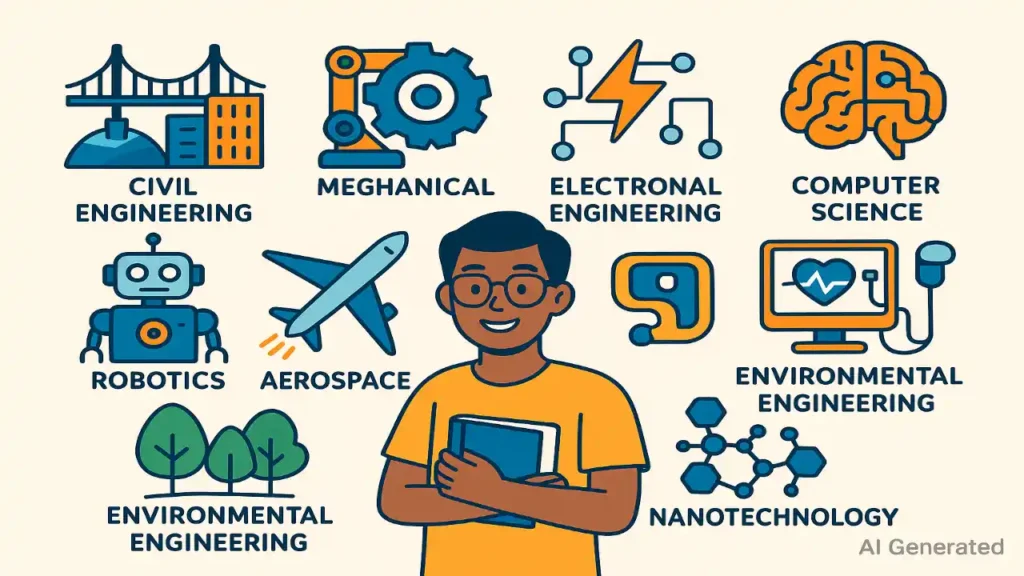
Illustration showing different types of engineering courses in 2025 including Civil, Mechanical, Electrical, Computer Science, Robotics, Aerospace, Biomedical, Environmental, and Nanotechnology with bright icons and modern education theme.
Career

How Many Types of Engineering Courses Are There in 2025? Complete Guide for Students

These days students always ask, “Guys, actually how many types of engineering courses are there?” And honestly, the first time you see the list, it can look a bit confusing. Civil, Mechanical, Electrical, and then AI, Robotics, Nanotechnology… all look different. I was confused too at first. But don’t worry, in this guide I will explain in a simple way—different engineering branches, types of engineering programs, and the full engineering course list for 2025, so you can decide which path to choose. Let’s start, in a friendly style, like I am personally telling you. Read Also : What Is Information Communication Technology? Understanding Engineering First, let’s know what engineering really is. Basically, engineering is a skill for problem-solving, where we use technology, design, and logic. Any bridge you cross, any app you use, or any machine you operate—an engineer made it. And when a student asks, “how many types of engineering courses are there?”, the short answer is… “a lot!”. But broadly we can divide them into core branches and specialized/emerging branches. Once you understand this, choosing becomes easier. Different Engineering Branches in 2025 Now let’s talk about different engineering branches. First, I will tell the traditional ones, then the new and exciting courses. Core Engineering Branches These are the branches that have always been popular: These branches are available in almost all colleges, and considered safe choices. Specialized / Emerging Engineering Branches With technology, new courses are also becoming popular: These specialized courses are not available in every college, but demand is growing very fast. Engineering Course List: Degrees and Programs When we ask “how many types of engineering courses are there”, it is not only about branches, we should also count degrees and programs. Undergraduate Programs Postgraduate Programs Diploma & Certification Tips to Choose the Right Engineering Branch Now, when the engineering course list is clear, choosing can be a bit tricky. Here are some simple tips: Major Engineering Branches Quick List 2025 This list is quite comprehensive, and colleges keep updating these courses according to industry needs. Emerging Trends in 2025 Engineering is not just limited to traditional branches. Check these trends: This shows engineering is continuously evolving, and new opportunities are opening. Conclusion So finally, “how many types of engineering courses are there?” The answer is… a lot! Broadly, core branches, specialized branches, undergraduate/postgraduate programs, diplomas, and certifications. Choosing engineering is not only about numbers, your interest and career goals are equally important. If you keep your interests, strengths, and future goals in mind, choosing the right branch becomes easy. FAQs Sources :Hindustan University – Types of Engineering Courses Types of Engineering Degrees BMU – Types of Engineering Courses

Project manager using AI tools on a laptop with clean minimal icons in a light professional background.
AI & Machine Learning, Career

How to Choose the Best AI Course for Project Management

To be honest, today when any project manager asks me — “Which AI course is best for project management?” — I say only one thing:“The course that actually solves your real project problems, not the one that only teaches fancy AI knowledge.” Because that’s the real game.Course length, platform name, certificate shine… all these are secondary. If a course cannot make your planning, execution, risk prediction, and daily workload easier, then honestly it is useless. Today AI is everywhere in project management, but that doesn’t mean every course is useful for you. So in this blog, I will explain everything in a simple, human way, like talking to a friend. I will tell you how to choose the best AI course, what to check, and how to know if the course will actually help your career. Read Also : What Are the Future Points for AI? Key Predictions for 2030 Why This Question Actually Matters “Which AI course is best for project management?” — this is not just a search question. It’s a real need. Because AI has changed project management completely. Now deadlines don’t run on guesswork.And now resource planning is not based on gut feeling.Now risk prediction doesn’t depend on Excel formulas. AI is performing so well that project managers who are not using AI are becoming less effective than those who are using AI. That’s why choosing the right course matters — a wrong course will waste time, and the right course will make you a next-level manager. AI Project Management Training Path This “AI for project managers” training path is not complicated. Only three things matter: If a course teaches you how AI helps in: …then the course is worth it. How to Identify the Best AI Course for Project Managers Now I will give you the practical points that help you choose the right course 100% correctly.This becomes your roadmap — which course to pick and which one to avoid. 1. Does the Course Teach Real Project Management Scenarios? See, anyone can teach theory.But the real value comes when the course shows: If there are no real examples, learning becomes half.The best course is the one that solves your daily PM problems using AI. 2. Is the Course Teaching AI Tools or Only Theory? Project managers don’t need coding.They need: If the course teaches real tools and gives hands-on practice — perfect.If it only gives concepts — skip it. 3. Does the Course Improve Your Core PM Skills? The best course is the one that improves your main PM skills: And when AI is added to these skills, your performance can double. This point also answers your focus keyword:“Which AI course is best for project management?”→ The one that gives both PM + AI skills together. AI-Powered Decision Making for Managers The biggest challenge in project management is decision making.And AI helps the most in this area. A good AI course teaches you: If the course doesn’t cover AI-based decision making, then the course is incomplete. 4. Certification Should Be Valuable (AI in Project Management Certification) A certification should be there — but not just for name.A valuable certification: But remember, complicated technical courses are not meant for project managers. 5. Course Should Be Beginner-Friendly and Practical Project managers are already busy.If a course is too technical, you will drop it halfway. The course must have: Only then will AI fit into your daily work. 6. Check Real Feedback — Did People Actually Improve? Reviews like “great course” don’t matter.You must check: If yes, then the course is worth it. Artificial Intelligence for Project Management Training — What Must It Include? A good PM-focused AI course must include: Without this combination, the course is incomplete. Benefits of Choosing the Right AI Course for Project Management If you choose a solid course, you can expect: These are real benefits, not hype. Avoid These Mistakes While Choosing an AI Course Many people make these mistakes: Avoid these and you will pick the right course easily. Conclusion — So Which AI Course Is Best for Project Management? If I answer in one line: “Which AI course is best for project management?”→ The course that teaches you how to use AI in project planning, execution, deadlines, team management, and prediction in real life. The course name doesn’t matter —The course impact matters. Choose a course that is: Remember this formula, and you will never waste time on the wrong course.

Top 10 Tech Jobs You Can Start After 12th Science.
Career

10 Tech Jobs You Can Start Right After 12th Science (No Degree Needed)

Introduction Have you ever thought about it? What if you could start your tech career right after 12th science, without even getting a degree? Sounds a bit strange, right? But honestly, it’s totally possible.In this blog, I’ll share the Top 10 tech jobs you can start after 12th science — real, skill-based careers that don’t need a fancy college degree but can still give you a strong start in the tech world. These days, companies care more about skills than degrees.Like if you know how to do things — build a website, create an app, or automate something — then bro, you’re already 50% ahead of those who are just chasing degrees. In this blog, I’m gonna explain in simple words — Top 10 tech jobs you can start after 12th science.These are the jobs where you can directly kickstart your career, without worrying about college. Read Also : Top 10 Computer Courses in Demand After 12th (2025) 1. Artificial Intelligence Jobs for Beginners AI… you’ve heard the name, right?It’s everywhere nowadays — ChatGPT, robots, face recognition, literally everything runs on AI. If you’re from a science background after 12th, you already understand basic logic and math.That’s enough to get started with AI.Begin with Python, then move on to machine learning and data analysis. Entry-level AI jobs you can go for: And the best thing — you can start right from home.There are free courses on YouTube and Coursera.Once you understand the basics, the possibilities are endless. 2. Web Development Jobs for Science Students If you like coding or have an interest in design, web development is perfect for you. Just imagine — you create your own website, design pages for clients, or even build an online store for a small business.All you need to learn is HTML, CSS, and JavaScript.Later, you can explore React or WordPress too. Web developer roles include: And the best part — you can start freelancing.That means earning money from home while growing your skills. 3. Data Science Career After 12th Now let’s talk about data science.The name sounds a bit heavy, but trust me — it’s super interesting. Every company wants to understand their data — profits, users, product performance, everything.And that’s exactly what you do — make sense of data and turn it into something useful. Start with Excel, Python, and SQL.Once you’re confident, move to tools like Power BI and Tableau. You can start as: And bro, this field is future-proof — demand is only increasing every year. 4. Cybersecurity Career Path After 12th Okay, imagine you’re the kind of person who loves breaking things just to see how they work Then cybersecurity is made for you. It’s basically about protecting systems and networks from getting hacked.Learn ethical hacking, phishing, and system security.Try sites like TryHackMe or Hack The Box for practice. Entry-level roles include: And one more thing — this field doesn’t just give money, it gives respect too.You literally help companies stay safe. 5. Robotics and Automation Jobs After 12th Have you ever built a robot? Or even thought about making one?If yes, then this field will excite you. Robotics is a mix of mechanical and coding skills.Start with Arduino and Raspberry Pi — you can easily get them online.Learn C and Python, and try small projects like automatic doors or motion sensor lights. You can begin as: It’s fun to work on and builds solid technical skills too. 6. Digital Marketing Career for Science Students Everything’s online now — business, shopping, learning… everything.So companies need people who can grow their brand online.And those people are called digital marketers. Your science background gives you an edge — you already understand logic and analytics.Now just learn: And yeah, this skill is a gold mine for freelancing.If you get an internship, even better! 7. Graphic Design and UI/UX Jobs After 12th If you’re into creativity and love designing — this field is just perfect. Learn tools like Canva, Figma, and Photoshop.Through UI/UX design, you make apps and websites look beautiful and easy to use. You can start as: Build a portfolio and look for projects online — clients are easy to find once you start. 8. Cloud Computing and IT Support Jobs Every app, every bit of data — it’s all on the cloud now.From Netflix to Google Drive — everything runs there.So yeah, cloud computing has a bright future. Learn the basics of AWS, Azure, and Google Cloud.Also, get some IT support knowledge — it’ll help you manage systems better. Job options include: This field helps you build a strong foundation in the IT industry. 9. Best Online Tech Courses After 12th Now the question is — “Bro, where do I start?”Simple — with online courses. Here are some of the best online tech courses after 12th that are genuinely useful: Just remember one thing — don’t pick everything at once.Choose one skill, master it, then move to the next. 10. Freelancing Tech Jobs for Students And now finally — freelancing, which basically means working for yourself. Whether you’re a web developer, designer, or digital marketer — freelancing is open for everyone.Just build a portfolio, create an account on Fiverr or Upwork, and start taking client work. Top freelancing tech jobs for students include: It takes a little patience in the beginning, but once you start getting projects, it feels amazing. Final Words So bro, these were the Top 10 tech jobs you can start after 12th science.I know — it feels confusing in the beginning, but just start.Overthinking won’t help, doing will. Skills matter more than degrees — and you can learn them right from home.Whatever field you choose, just stay consistent.One day, you’ll look back and say — “Yeah, I made the right decision.” FAQs – Tech Jobs After 12th Science

Which 6 month computer course is best?
Career

Top 10 Job-Oriented 6-Month Computer Courses in 2025 (High Salary Career Options)

Introduction Have you ever thought about setting up your career in just 6 months?Yes, I’m serious — in today’s time, having a full degree isn’t really necessary anymore.Just pick the right 6-month computer course, and with the power of skills, you can land a good job — with a nice salary too. In today’s blog, we’ll talk exactly about that — Which 6 month computer course is best?Which courses have great future scope, which platforms are best to learn from, and what things you should keep in mind while choosing the right course — we’ll cover everything in simple words. Read Also : Top 10 Computer Courses in Demand Worldwide in 2025 (with Salary by Region) 1. Digital Marketing Course In today’s digital world, everything is online — business, shopping, entertainment, everything.So digital marketing is one of those skills that will never lose demand.Just take a 6-month course and you’ll learn things like SEO, Google Ads, Instagram marketing, and email campaigns. If you’re a bit creative, enjoy working with numbers, and love exploring the online world — this course is perfect for you.For beginners, this is considered one of the most job-oriented 6-month courses. 2. Graphic Designing Course Every brand needs visuals — logos, banners, posters, reels, everything.That’s why the demand for graphic designers is sky-high right now.You can learn tools like Photoshop, Illustrator, and Canva, and start freelancing or even get a full-time job. And honestly, if you love creativity, this course will never feel boring.In just 6 months, you’ll turn into a design magician 3. Web Designing and Development Creating websites has become a basic need now.Every business wants to have its own website — that’s why web developers are valuable everywhere.Learn HTML, CSS, JavaScript, and WordPress, and your career can take off. After completing this course, you can work as a freelancer or join an IT company.So if you ask me Which 6 month computer course is best?, web development will always be on top. 4. Data Analytics Course Every company today runs on data — what customers like, which products are selling more, everything comes from data.By learning data analytics, you become a goldmine for companies.Learn Excel, SQL, Power BI, and Python basics to start your journey as an analyst. The salary is pretty good too — even freshers can earn ₹5–8 LPA if their skills are strong. 5. Artificial Intelligence (AI) & Machine Learning Course Now this one is a high-skill and high-salary course.AI and ML are the most in-demand technologies today — ChatGPT, self-driving cars, Netflix recommendations, all run on them. In 6 months, you can learn the basics, get an entry-level job, and later specialize to build a solid career.It’s a bit tough, but totally worth it. 6. Cybersecurity Course With data leaks, hacking, and scams increasing on the internet, the demand for cybersecurity experts is rising at rocket speed.You’ll learn how to secure networks, check system vulnerabilities, and even do ethical hacking. If you enjoy problem-solving and investigating things, this course is perfect for you. 7. Tally & Accounting Course For students from a commerce background, this is one of the safest and quickest courses.In 6 months, you’ll learn the Tally ERP9 software and GST management.After this, you can work as an accountant, billing executive, or GST consultant. Its value in the job market is stable — there’s always demand for it. 8. App Development Course The craze for mobile apps is never going away.Learn Android or iOS development — companies will hire you, or you can even create your own app and earn money. This course involves some coding, but nowadays, no-code tools are also available, making it easier for beginners. 9. UI/UX Design Course UI/UX design isn’t just about making pretty designs — it’s about improving user experience.You’ll learn how to make an app or website more user-friendly. Every tech company needs UI/UX designers, and the salary is quite good.If you’re both analytical and creative, this course is perfect for you. 10. Video Editing Course In the era of YouTube, Instagram Reels, and short videos, the demand for video editors is everywhere.Learn tools like Adobe Premiere Pro, After Effects, and CapCut, and you can easily start freelancing or get a job. One more plus point — this skill will also help you in creating your own social media content! Which 6 Month Computer Course Has the Best Career Scope? See, it depends on what field you’re interested in.If you like marketing and creativity — then digital marketing and graphic design are perfect.If you enjoy logic and coding — then web development and AI/ML are the best options.And if you want a secure future, cybersecurity is the king. All these courses have great scope; you just need to stay consistent and focused. Best Online Platforms for 6-Month Computer Courses Nowadays, you can take the best courses sitting right at home.Here are some trusted online platforms: All of these are perfect for beginners and also provide certificates that look great on your resume. Tips to Choose the Right 6-Month Computer Course It’s natural to feel a bit confused while choosing a courseBut just follow these simple tips: Keep these 5 points in mind and there’s almost zero chance of making the wrong choice. Conclusion So friends, now you must have got a clear idea about Which 6 month computer course is best?Actually, the best course is the one where your interest and dedication meet.Six months may sound short, but if you stay focused, it can completely change your career path. In today’s time, skill is everything — more than a degree.So choose smartly, keep learning, and get ready to start a brand-new chapter of your career after just six months. FAQ Section (Human, Simple & Conversational)

Top 10 Computer Courses in Demand Worldwide
Career

Top 10 Computer Courses in Demand Worldwide in 2025 (with Salary by Region)

Introduction Honestly speaking — in today’s time, everyone wants to do something in the tech field.Whether you’re a college student, a working professional, or someone looking to switch careers — one question is always there in everyone’s mind:“Which computer course should I do that gives me both a job and a good salary?” So, in this blog, we’ll explore the top 10 computer courses in demand in the world that can help you build a successful and future-ready tech career. And that’s exactly what we’re going to talk about today.Let’s explore the Top 10 computer courses in demand in world for 2025 — with global salary insights, career growth, and why they’re leading the tech industry right now. No fancy jargon, no textbook feel — just simple talk with real-world clarity. Read Also : Top 10 Computer Courses in Demand After 12th (2025) 1. Artificial Intelligence (AI) and Machine Learning (ML) Let’s start with the showstopper — AI and Machine Learning.In 2025, this combo is like the Sachin Tendulkar of the tech world — the most in-demand, the fastest growing, and the highest paying. AI and ML professionals teach machines how to think and make decisions like humans.From ChatGPT to self-driving cars — everything runs on this technology. Average Salary:💰 USA: $120,000/year💰 India: ₹15–25 LPA💰 UK: £60,000/year Why it’s in demand: Keyword Insight:If someone searches for “best computer courses for high salary worldwide” — this one always comes first. 2. Data Science and Analytics You might wonder, “What’s the next big thing after AI?”The answer is Data Science — because data is literally the new oil. Data scientists analyze complex data and turn it into smart business decisions.It’s a perfect mix of coding, statistics, and storytelling. Average Salary:💰 USA: $110,000/year💰 India: ₹12–20 LPA💰 Canada: CAD 95,000/year Why it’s booming: Pro Tip: Learn Python, Power BI, and SQL — these tools are must-haves. 3. Cybersecurity and Ethical Hacking As the digital world grows, cyberattacks are also increasing.That’s where cybersecurity experts step in — the digital superheroes who protect data and networks from hackers. Average Salary:💰 USA: $105,000/year💰 India: ₹10–18 LPA💰 UAE: AED 250,000/year Why it’s hot in 2025: Search Trend:This course is always trending under “in-demand IT courses for future.” 4. Cloud Computing (AWS, Azure, Google Cloud) Don’t get confused when you hear “cloud” — it’s not about rain 😄Here, it’s about storing and managing data online. Cloud computing experts handle servers, storage, and apps over the internet. Average Salary:💰 USA: $115,000/year💰 India: ₹14–22 LPA💰 Germany: €75,000/year Why it matters: 5. Full Stack Web Development This course is evergreen — because websites and apps will never go out of trend.Full stack developers handle both front-end (design) and back-end (logic). Average Salary:💰 USA: $100,000/year💰 India: ₹8–16 LPA💰 Australia: AUD 110,000/year Why it’s popular: Bonus: Learn React, Node.js, and MongoDB to stand out. 6. UI/UX Design and Product Design A good design isn’t just pretty — it understands users.That’s where UI/UX designers shine. They create experiences that make apps and websites easy to use and visually attractive. Average Salary:💰 USA: $95,000/year💰 India: ₹9–15 LPA💰 UK: £55,000/year Why trending: This course often ranks under “most popular computer courses in 2025.” 7. Blockchain Technology This is not just about Bitcoin.Blockchain is transforming industries like finance, healthcare, and even voting systems. It’s about building secure, transparent digital systems. Average Salary:💰 USA: $120,000/year💰 India: ₹18–25 LPA💰 Singapore: SGD 130,000/year Why in demand: 8. DevOps and Automation Creating software is one part — maintaining it is another art.That’s where DevOps engineers come in — bridging the gap between development and operations. Average Salary:💰 USA: $110,000/year💰 India: ₹12–20 LPA💰 UK: £65,000/year Why popular: This one also fits under “in-demand IT courses for future” because automation is the new standard. 9. Digital Marketing and SEO Most people think digital marketing is only about social media — but it’s much more than that.It’s a powerful computer-based career combining creativity and analytics. You learn to manage ads, SEO, campaigns, and brand visibility. Average Salary:💰 USA: $85,000/year💰 India: ₹6–12 LPA💰 UK: £45,000/year Why it’s still booming: 10. Programming and Coding Courses (Python, Java, C++) Now let’s come back to the foundation — Programming.Every tech career starts here. Among the top programming languages to learn in 2025, Python is still the king, followed by Java, C++, and Go. Average Salary:💰 USA: $95,000/year💰 India: ₹8–15 LPA💰 Germany: €70,000/year Why it’s always relevant: Best Online Computer Courses with Certificates (Quick Picks) If you don’t have much time but still want to upgrade fast, here are some best online computer courses with certificates worth checking out: These short courses help you enter the global tech job market faster. Highest Paying Computer Courses Globally (2025 Snapshot) Course Avg Global Salary (USD/year) Top Hiring Regions AI & ML $120,000 USA, UK, India Data Science $110,000 Canada, Europe Cybersecurity $105,000 UAE, USA Cloud Computing $115,000 USA, Germany Blockchain $120,000 Singapore, India Final Thoughts — Your Next Step So in simple Anand-style —If you really want to make your career secure and future-proof,then these Top 10 computer courses in demand in world are your perfect roadmap. Just remember one rule — the process of learning should never stop.Technology will keep changing, but only those who adapt will move ahead. The 2025 tech world belongs to those who are not only skilled but also smart. FAQs — Top 10 Computer Courses in Demand World

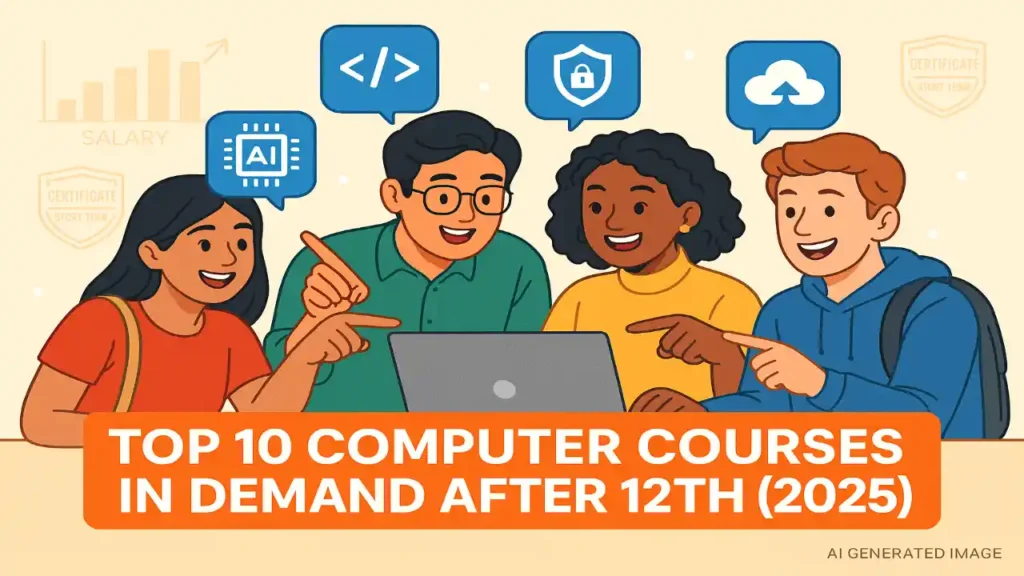
Students exploring top 10 computer courses in demand after 12th with icons of AI, web development and cybersecurity
Career

Top 10 Computer Courses in Demand After 12th (2025)

Introduction Look, after 12th, one question always hits everyone’s mind — what to do next?Especially for those students who come from science, commerce, or arts backgrounds but have an interest in computers and technology. In today’s time, computer skills have become the base of every industry — whether it’s marketing, finance, design, or data. So today, let’s talk in simple words about Top 10 Computer Courses in Demand After 12th (2025).I’m writing this blog as if I’m personally explaining it to you — no technical jargon, just straight and clear talk. Read Also : Is Graphic Design Still a Good Career in 2025? The Honest Truth from Designers & Experts 1. Data Science and Analytics If you love numbers and logic, this course is a top pick.Data Science is basically a field where companies analyze their data to make better decisions. Here you’ll learn Python, statistics, machine learning, and visualization tools.The course duration is around 6 months to 1 year (there are short-term & certificate options too). Average Salary Snapshot: ₹6–10 LPA in India, depending on your skill and experience. 2. Digital Marketing Everything is going online now — shopping, learning, even business.That’s why digital marketing has become one of the booming career choices. In this course, you’ll learn SEO, social media marketing, email campaigns, and paid ads.It’s perfect for those who are creative and good at communication. Salary Snapshot: Starting from ₹3–5 LPA, and with experience, it can go beyond ₹10 LPA. 3. Graphic Designing If you’re into designing and creativity, this course is definitely worth trying.After learning tools like Photoshop, Illustrator, and Canva, you can even start freelancing. This field is not just about art — it’s in high demand for marketing and branding too. Short-term & Certificate Options: 6 months to 1 year diploma available. Salary Snapshot: ₹3–7 LPA, with growth in both freelancing and full-time roles. 4. Web Development It’s hard to imagine the world without the internet — and websites are its backbone.In a web development course, you’ll learn HTML, CSS, JavaScript, and frameworks like React and Node.js. If you enjoy coding, this field is perfect for you.You can go for front-end or back-end — both have great opportunities. Salary Snapshot Table: Level Salary Range Beginner ₹3–5 LPA Mid-level ₹6–9 LPA Expert ₹10+ LPA 5. Cybersecurity With online scams and hacking increasing, the demand for cybersecurity experts is sky-high.This course is for students who are deeply interested in computers and networking. You’ll learn about network security, ethical hacking, penetration testing, and more.Both government and private sectors value this skill highly. Average Salary: ₹5–12 LPA depending on your expertise. 6. Artificial Intelligence and Machine Learning AI is the buzzword of today — and honestly, this field is exploding right now.In this course, you’ll learn how to train machines to make decisions like humans. Python, TensorFlow, and deep learning are part of it.If you can handle a bit of math and coding, this course is pure gold for your future. Salary Snapshot: ₹8–15 LPA for AI engineers and data scientists. 7. Cloud Computing When companies store their data online, that process is called cloud computing.AWS, Google Cloud, and Microsoft Azure are the top platforms in this field. This course is best for IT students who want to work on secure and scalable systems. Salary Range: ₹6–14 LPA, depending on your certifications and project exposure. 8. Mobile App Development Every person has multiple apps on their phone — and every business now wants one too.In this course, you can learn Android (Java/Kotlin) or iOS (Swift) app development. Once you master app building, doors open for freelancing as well as startups. Short-term & Certificate Options: 6–8 months courses are available. Salary Snapshot: ₹4–10 LPA depending on your projects and platform. 9. UI/UX Designing Here, design and psychology meet together.UI/UX designers decide how an app or website should look and how users will interact with it. You’ll learn tools like Figma, Adobe XD, wireframing, and prototyping. Salary Snapshot: ₹5–9 LPA, and with experience, it can easily reach ₹15 LPA. 10. Blockchain Technology With the rise of crypto, the demand for blockchain experts has also grown rapidly.This technology is used for secure transactions and smart contracts. In this course, you’ll learn about cryptography, distributed ledgers, and smart contracts. Salary Snapshot: ₹8–20 LPA — high demand, fewer skilled people. How to Choose the Right Course Now comes the main question — “With so many options, which one should I pick?”Here’s a simple approach: Every course is great in its own way — just match it with your interest and career goals. Why These Courses Are in Demand in 2025 Conclusion So overall, if you’re wondering “what to do after 12th?”, then the computer field is a solid choice.Whether you’re from commerce, arts, or science — if you have dedication, you can learn any skill. Just start with one course and slowly build your portfolio.Remember, practical skills matter more than just a degree. So these were the Top 10 Computer Courses in Demand After 12th (2025) — now the decision is yours, and the future is in your hands. FAQs

Scroll to Top