
Introduction
Have you ever noticed how fast the education system has changed in the last few years? Earlier classrooms were limited to blackboards, and now… AI is literally everywhere. And honestly, when people ask “how ai helps in education?”, I feel it is important to explain this topic in simple words.
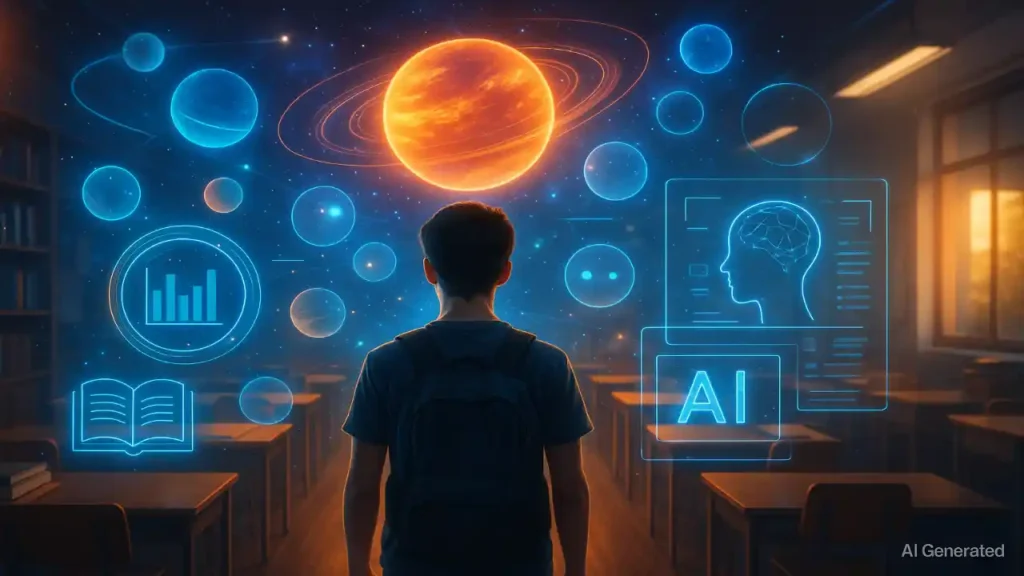
Today’s student is not the same anymore. Their learning style has changed. Their expectations have changed. And teachers are also adapting with technology.
AI works like a bridge between all of this — a tool that makes learning more personal, makes teaching easier, and makes education smarter overall.
Let’s look at this topic from a very practical angle:
- How AI is used in real classrooms
- Which AI tools for students actually work
- And what the future of education will look like
The tone will be simple, like I am sitting and talking to you. Let’s start.
Read Also : How Does AI Technology Work? Simple Guide for 2025
How AI Helps in Education
If I say it in simple words, the main work of AI in education is to make learning smart, personalized, and efficient. Earlier, teachers needed time to understand the pace of each student. Now AI automatically analyzes and shows where a student is struggling.
This kind of smart analysis was not possible earlier. And this is where AI shows its real power.
1. Personalized Learning for Every Student
Today, the biggest advantage is this — the benefits of AI in learning are not limited to theory.
AI tracks every student’s:
- speed
- memory
- strengths
- weak areas
And then suggests study material based on that.
If you think about it, it’s difficult for a teacher to guide 40 students individually… but AI makes this easy.
Example:
If a student is slow in math, AI gives extra practice. But if another student is doing well, the AI increases the difficulty level.
This is real personalization — something that wasn’t this smooth before.
2. Instant Feedback & Better Assessments
Teachers like this point the most.
AI systems instantly show whether a student’s answer is right or wrong, or if their approach is incorrect.
Because of this:
- students get quick understanding
- teachers save checking time
- learning becomes faster
And yes, AI never gets tired — so there are fewer checking mistakes.
3. AI-Powered Teaching Solutions
This might sound technical, but it is quite simple.
Today, AI works like an assistant for teachers.
AI-powered teaching solutions help with:
- planning lessons
- simplifying tough concepts
- creating quizzes and assignments
- tracking student progress
You can say AI reduces half of the teacher’s workload.
And when workload reduces, teachers can focus on actual teaching — which is the main goal.
4. Smart Classrooms & Interactive Learning
A smart classroom doesn’t mean just installing screens.
A smart classroom means making learning engaging.
With AI, students can:
- see visual simulations
- use voice assistants
- do experiments with 3D tools
And honestly, when students get engaged, their concept understanding becomes much stronger.
Imagine a tough physics topic… AI shows it in a 3D animation. It becomes so easy!
Real Classroom Examples of How AI Helps in Education
This part is very important because real examples help people understand better.
Let’s see some practical examples used in schools and colleges.
Example 1: AI Homework Helper
Earlier students had to wait until next day’s class.
Now AI apps explain their doubts instantly — step-by-step.
Teachers also like this because students come prepared.
Example 2: AI Reading Assistants
For young students, AI helps a lot in improving reading.
AI listens to their pronunciation, highlights mistakes, and gives real-time feedback.
It becomes a very natural learning process.
Example 3: Smart Essay Checker
In colleges, AI tools check grammar, structure, and clarity.
They suggest improvements and guide students to write better.
Without giving extra work to teachers, students still improve.
Example 4: AI Data Insights for Teachers
Teachers get clear reports showing which student is weak in which area.
These kinds of insights were almost impossible with manual checking.
This makes teaching more strategic.
Example 5: Virtual AI Tutors
Students can learn a topic again and again through AI tutors.
AI does not get angry, AI does not get bored…
Students can revise as many times as they want.
AI Tools for Students
Let’s talk practically.
Which AI tools for students are actually useful?
These tools help students with:
- making study plans
- summarizing content
- clearing doubts
- improving writing
- exam preparation
Common tools used by students:
- note-taking assistants
- quiz generators
- flashcard tools
- AI math solvers
- reading support tools
- language learning apps
All of these have one simple goal — making learning easier and reducing stress.
Role of Artificial Intelligence in Education
If we look broadly, the role of artificial intelligence in education has three main areas:
- improving learning
- improving teaching
- improving the overall system
AI is not replacing teachers.
It is only reducing their workload so classrooms can function better.
And honestly, the whole system becomes smarter automatically.
Benefits of AI in Learning
Let’s keep this simple:
1. Learning becomes faster
Students understand concepts more quickly.
2. Learning becomes personal
Every student gets what they need individually.
3. Students become confident
Instant feedback increases motivation.
4. Teachers get more time
Less admin work, more teaching.
5. Learning becomes fun
Interactive tools make subjects more enjoyable.
Future of Learning with AI
Now let’s look a little into the future.
In the coming years, the education system will become even more advanced — and AI will be its main support.
Future trends you will see:
- fully AI-based adaptive tests
- virtual classrooms with AI avatars
- personalized textbooks
- AI-guided career advice
- teaching styles based on emotion detection
Honestly, in the next 10 years, learning will look so different that today’s system will feel outdated.
Conclusion
If I say it simply, the answer to how ai helps in education is this —
AI makes learning smarter, more personal, and more accessible.
Teachers get support, students get clarity, and the education system becomes better.
In the future, AI will be even more deeply connected to education.
And as long as it is used in a balanced and ethical way, it will always be a helpful part of the system.
FAQs

- GEO vs SEO: How AI Search Optimization Tools Increase Organic Traffic Beyond Google Rankings - January 23, 2026
- Why Use AI Search Monitoring Tools in 2026? (Benefits, KPIs & ROI With Examples) - January 22, 2026
- How to Improve Brand Visibility in AI Search Engines in 2026 - January 21, 2026