
Introduction: Why Everyone Is Talking About AI in Development
If you’ve been around software development for even a few years, you’ve probably noticed something. Things are moving faster. Deadlines are tighter. Expectations are higher. And somehow, teams are still expected to ship clean, stable software.
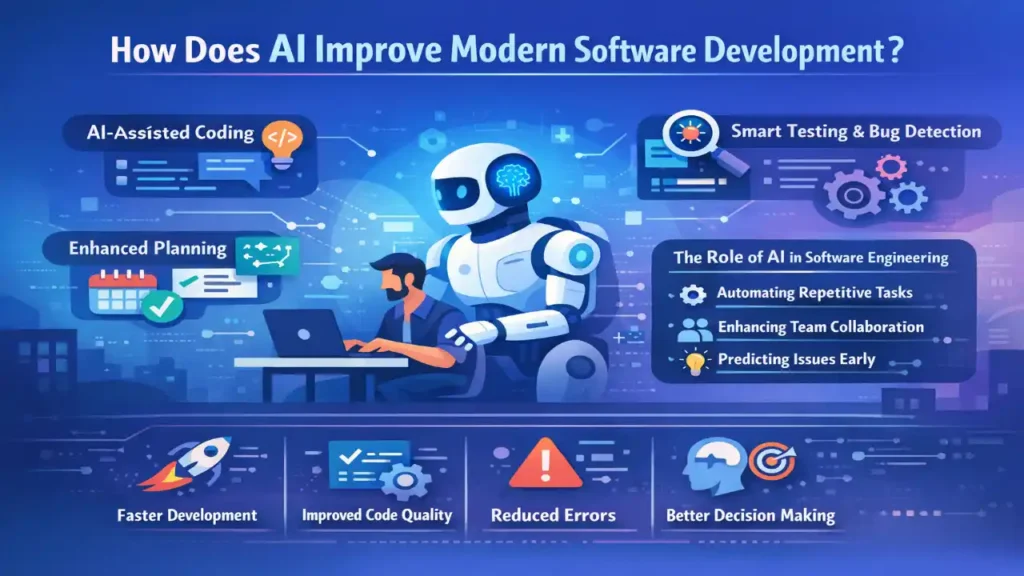
This is where the real question comes in — how does AI improve modern software development, not in theory, but in real day-to-day work?
AI is no longer some future concept or experimental idea. It’s already sitting inside coding tools, testing systems, project planning, and even documentation. Developers may not always notice it, but it’s quietly changing how software gets built, reviewed, tested, and maintained.
In this blog, I’ll break things down simply. No hype. No sales talk. Just a clear explanation of the role of artificial intelligence in software development, where it actually helps, and why so many teams are adopting it.
Read Also : Which Is the Most Popular AI Tool in 2025?
Understanding AI in Software Development (In Simple Words)
Before jumping into benefits, let’s clear one thing up.
AI in software development does not mean machines replacing developers. That fear gets repeated a lot, but it misses the point.
AI works more like an assistant.
It studies patterns, learns from data, and helps developers make better decisions faster. Whether it’s suggesting code, finding bugs, or predicting issues before they happen, AI is there to reduce manual effort, not remove human thinking.
In modern workflows, AI supports developers in areas where repetition, speed, and accuracy matter most.
And honestly, that’s where most teams struggle.
How Artificial Intelligence Enhances the Software Development Lifecycle
One big reason AI fits so well into development is because software follows a lifecycle. From idea to launch, there are multiple stages. AI helps at almost every step.
Planning and Requirement Analysis Becomes Smarter
Early-stage planning often feels messy.
Requirements change. Stakeholders say one thing today and another tomorrow. AI helps teams analyze historical data, user behavior, and previous project outcomes to spot patterns early.
This improves estimation accuracy and reduces surprises later.
Small improvement here saves a lot of trouble later.
AI-Assisted Coding Improves Speed and Accuracy
This is probably the most visible area where AI improves modern software development.
AI-powered coding assistants analyze context and suggest code snippets in real time. Instead of searching documentation or rewriting common logic again and again, developers get suggestions instantly.
This doesn’t remove thinking. It removes friction.
And when friction is reduced, developers focus more on logic and architecture rather than syntax.
Smarter Code Reviews with AI Support
Code reviews are important, but they’re also time-consuming.
AI can scan code for:
- Common errors
- Security vulnerabilities
- Performance issues
- Style inconsistencies
This allows human reviewers to focus on logic, design, and edge cases instead of basic mistakes.
That balance improves code quality without slowing teams down.
Benefits of AI in Software Engineering You Can Actually Feel
Now let’s talk clearly about the benefits of AI in software engineering, not abstract ones, but real improvements developers notice.
Faster Development Without Cutting Corners
Speed matters, but not at the cost of quality.
AI helps teams write, test, and review code faster without skipping best practices. Automated suggestions and testing reduce manual workload while keeping standards intact.
That’s a rare win-win in software projects.
Reduced Human Error in Critical Areas
No matter how experienced a developer is, mistakes happen.
AI tools catch patterns humans miss, especially in large codebases. From memory leaks to logical flaws, AI reduces the risk of silent failures.
This leads to more stable releases and fewer late-night emergency fixes.
Better Focus on Problem-Solving
Developers didn’t choose this career to rename variables or fix formatting issues.
By handling repetitive tasks, AI frees mental space. Teams can focus on architecture, scalability, and user experience — the things that actually define good software.
This shift alone improves job satisfaction and product quality.
Role of Artificial Intelligence in Software Development Beyond Coding
Many people think AI’s role ends at writing code. That’s not true.
The role of artificial intelligence in software development extends much further.
AI in Automated Testing and Quality Assurance
Testing often delays releases.
AI-based testing tools automatically generate test cases, predict high-risk areas, and adapt tests when code changes. This reduces regression bugs and speeds up validation cycles.
More coverage, less effort — that’s the real value here.
Predictive Bug Detection and Maintenance
Instead of reacting to bugs after users complain, AI helps teams act earlier.
By analyzing usage patterns and logs, AI predicts where issues are likely to appear. This allows teams to fix problems before they turn into outages.
Preventive maintenance is one of the most underrated benefits of AI.
Documentation and Knowledge Management
Let’s be honest. Documentation is often outdated or incomplete.
AI can generate summaries, explain code logic, and help onboard new developers faster. When knowledge stays accessible, teams move smoothly even when people change.
That stability matters more than people realize.
Why AI Improves Collaboration in Modern Development Teams
Software development is not just about writing code alone.
AI improves communication by:
- Summarizing tickets and discussions
- Highlighting priority issues
- Assisting in task assignment
This keeps everyone aligned and reduces confusion, especially in remote teams.
Clear communication means fewer misunderstandings and smoother delivery.
Human Developers Still Matter (More Than Ever)
Here’s an important point.
Even though AI improves modern software development, it doesn’t replace creativity, judgment, or responsibility.
AI doesn’t understand business context the way humans do. It doesn’t feel user frustration or product vision. Developers still make final decisions.
AI just helps them make better ones.
Common Misconceptions About AI in Software Development
Some misunderstandings keep floating around, so let’s clear them quickly.
- AI does not replace developers
- AI does not eliminate bugs completely
- AI does not think creatively
What it does is support, enhance, and accelerate development workflows.
Once teams accept this, adoption becomes easier.
How AI Fits into the Future of Software Development
Looking ahead, AI will become less visible but more powerful.
Instead of flashy tools, we’ll see:
- Better workflow automation
- Smarter decision support
- Deeper integration into development environments
The teams that learn to work with AI, not against it, will adapt faster.
And that’s the real advantage.
Ethical and Security Considerations When Using AI in Development
While talking about how AI improves modern software development, we also need to slow down for a second and look at the responsibility side.
AI is powerful, but it’s not neutral by default.
Data Privacy and Security Risks
AI tools learn from data. And sometimes, that data includes sensitive code or user information.
If teams blindly feed everything into AI systems without control, it can create security risks. That’s why modern development teams must be careful about:
- What data is shared
- How models are trained
- Where AI tools are hosted
AI helps development, but security decisions still need humans.
Bias and Blind Trust in AI Suggestions
AI suggestions look confident. Sometimes too confident.
If developers accept everything without reviewing logic, errors can slip through. AI learns from existing patterns, and those patterns may include poor practices or bias.
This is why AI should assist, not decide.
Human review is not optional. It’s necessary.
Limitations of AI in Modern Software Development
To keep things honest, let’s talk about where AI still struggles.
Yes, AI in software development is improving fast, but it has limits.
Lack of Deep Context Understanding
AI doesn’t fully understand business goals, emotions, or long-term product vision.
It can suggest efficient code, but it won’t always know why something exists or what trade-off matters most.
That judgment still comes from experience.
Dependency Risk if Teams Rely Too Much
When teams rely heavily on AI tools, skill erosion can happen.
Developers might stop learning fundamentals if AI handles everything. Over time, this weakens problem-solving ability.
The smartest teams use AI as a helper, not a crutch.
How AI Improves Decision-Making for Software Teams
One underrated benefit of AI in software engineering is better decision support.
AI doesn’t just help with execution; it helps with choices.
Smarter Estimation and Planning
By analyzing past projects, AI can predict timelines, identify risk areas, and suggest better planning strategies.
This reduces unrealistic deadlines and improves trust between technical and non-technical teams.
Better planning leads to calmer development cycles.
Improved Resource Allocation
AI helps identify where effort is being wasted.
By spotting bottlenecks and repetitive tasks, teams can adjust workloads and prioritize meaningful work.
This makes development more sustainable in the long run.
Real-World Impact: What Developers Actually Experience
Let’s bring this back to reality.
Developers who work with AI daily often notice small but meaningful changes.
- Less time fixing trivial issues
- Faster debugging cycles
- Cleaner pull requests
- More focus on logic and architecture
These small wins add up.
That’s how AI improves modern software development — not overnight, but steadily.
Why AI Adoption Feels Different for Every Team
Not every team experiences AI the same way.
That’s because success depends on:
- Team maturity
- Tool selection
- Process alignment
Teams that treat AI as part of their workflow benefit more than those who treat it as a shortcut.
Implementation matters more than tools.
The Evolving Role of Developers in an AI-Driven World
Here’s an interesting shift happening quietly.
As AI takes over repetitive tasks, developers are becoming more like problem solvers and system thinkers.
The role of artificial intelligence in software development is pushing humans toward higher-value work.
That’s not a threat. That’s growth.
Balancing Automation and Human Creativity
AI is good at patterns.
Humans are good at creativity.
Modern software development improves when both work together. Automation handles repetition. Humans handle innovation.
This balance is what defines strong engineering teams today.
Final Thoughts: So, How Does AI Improve Modern Software Development?
If we strip away the hype and noise, the answer is actually simple.
AI improves modern software development by making work smarter, not harder.
It:
- Reduces repetitive effort
- Improves code quality
- Speeds up testing and delivery
- Supports better decisions
- Helps teams focus on real problems
But it doesn’t replace human thinking.
AI works best when developers stay in control, review decisions, and use it with intention.
That’s the real future of software development — human-led, AI-supported.

- GEO vs SEO: How AI Search Optimization Tools Increase Organic Traffic Beyond Google Rankings - January 23, 2026
- Why Use AI Search Monitoring Tools in 2026? (Benefits, KPIs & ROI With Examples) - January 22, 2026
- How to Improve Brand Visibility in AI Search Engines in 2026 - January 21, 2026