
Honestly, these days we hear the word AI so much that sometimes it feels like everything is being run by AI. Phones, apps, cars, even your Netflix recommendations — AI is involved somewhere in all of them.
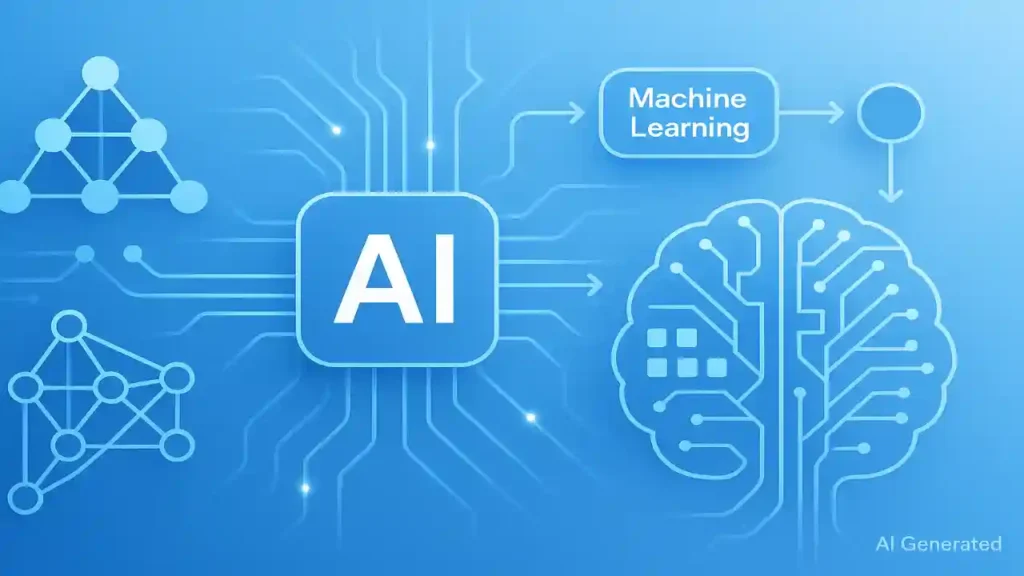
But the real problem is that people get confused before even understanding AI. So much fancy language, so many difficult terms… not at all friendly for normal humans.
So in this blog, I want to explain everything in simple, normal, human language. Just like I am sitting with you and explaining it. No complicated formulas. No tech-heavy attitude. Just straight, easy, real-life style.
And yes, throughout the blog I’ll naturally use our focus keyword: how does ai technology work — so that Google also understands what the content is about.
Let’s start.
Read Also : How AI Is Changing the World in 2025
Basics of AI Technology Explained (Human Style, No Jargon)
First, a simple fact — AI is not magic. It is basically a technique to teach computers how to “think.”
Let me give you an example. When you teach a small kid the difference between a cat and a dog:
You show cat photos
Then dog photos
Then you keep saying: “This is a cat,” “This is a dog”
Slowly the kid learns to identify them on their own.
AI also follows the same process. The only difference is that a kid uses the human brain and AI uses machine learning models.
So when someone asks: “How does AI technology work?”
I simply say:
“It learns from data, finds patterns, and then makes predictions.”
That’s it. This is the simple idea.
How Artificial Intelligence Works Step By Step (Super Simple Breakdown)
Now let’s break it down step-by-step, because Google loves this and humans love clarity.
Step 1 — It collects data
AI first receives data like:
Photos
Text
Videos
Voice recordings
The more data AI sees, the smarter it becomes.
Simple.
Step 2 — The data is cleaned
Just like humans, AI can also get confused by wrong or messy data.
So the data is cleaned:
Remove errors
Remove duplicates
Remove useless parts
It’s just like cleaning a hostel room — otherwise nothing makes sense.
Step 3 — It finds patterns
Here the real “brain” of AI works.
It looks for patterns in:
Sentence structure
Pixels of an image
Voice waves
Human behavior trends
AI is very good at finding patterns. Humans can miss things, but AI rarely does.
Step 4 — The model gets trained
Now AI is trained — just like going to the gym.
More training = better output.
During training, AI:
Makes guesses
Gets correct
Makes mistakes
Learns to fix mistakes
This loop continues again and again.
Step 5 — It gives the final output
And finally, when you give AI a task like:
“What’s in this photo?”
“Translate this sentence.”
“Give me suggestions.”
AI gives an answer based on the patterns it learned.
That’s the whole machine learning and AI working process — simple, friendly, no drama.
How Does AI Technology Work Behind the Scenes? (A Real-Life Perspective)
You might have noticed how Google Maps tells you exactly where the traffic is stuck.
Or how Instagram shows you only those reels that you will enjoy.
This is the “behind the scenes” part of AI.
Here’s a small example:
Example Google Maps AI
Millions of phones share location
AI checks if cars are moving fast or slow
Machine learning analyzes traffic levels
Then AI suggests the best route
You think the map is smart.
But actually, the real smart thing is the AI working silently in the background.
Example Instagram Reels Suggestion
Many people don’t know this.
Instagram’s AI checks:
What you like
What you scroll
What you watch again
How many seconds you stay
Then AI builds your pattern:
“This person likes travel, gym, and funny reels.”
Then it shows only those things.
This is exactly how does ai technology work in your daily life.
Machine Learning and AI Working Process (Super Human Explanation)
This phrase sounds a bit technical, but let’s make it human-friendly too.
The machine learning and AI working process is like this:
AI gets examples
Then AI creates its own “rules” from those examples
Then AI uses those rules to understand new things
Let’s take an example:
You have a fridge at home.
You know:
Cold things go in the fridge
Hot things go on the stove
Dry snacks go on the shelf
You created these rules yourself.
AI also creates rules in the same style — the only difference is that AI has millions of examples.
Real-Life Examples That Explain How AI Works
AI becomes real for people only when they hear real-life examples.
So here are some examples that everyone can easily relate to.
1. Your Phone’s Face Unlock (Computer Vision AI)
When you unlock your phone with your face, AI:
Detects eyes
Detects nose
Detects jawline
Matches patterns
Calculates confidence score
If everything matches → phone unlocks.
2. YouTube Auto-Subtitles (Speech Recognition AI)
YouTube’s AI converts audio into text.
How?
Breaks voice into small chunks
Analyzes waves
Matches word patterns
Generates text
Sometimes it writes something wrong — just like humans.
3. Netflix Recommendations
Netflix tracks:
What you watch
How long you watch
Where you skip
Which genre you love
Then AI recommends the perfect shows for you.
Why AI Sometimes Makes Mistakes Like Humans (Important Point)
AI is not perfect.
Sometimes it gives wrong answers.
But why?
Because AI also guesses based on patterns.
If the pattern is incomplete or the training data is biased, AI makes mistakes.
Like:
Your phone detecting the wrong face
YouTube subtitles showing weird words
Google giving incorrect predictions
These small human-like mistakes show that AI is not a robot — it’s just a trained system.
Summary So Finally, How Does AI Technology Work?
If I explain it in one simple line:
“AI learns from data, finds patterns, and then makes decisions or predictions based on those patterns.”
And yes — the more data it has, the smarter it gets.
Conclusion (Clear, Friendly Ending)
I hope now you clearly understand how does ai technology work in the simplest possible way.
You saw real-life examples, step-by-step working, and you also saw that AI learns almost like humans — the only difference is that AI is extremely fast.
Today’s AI handles everything from simple tasks to complex operations.
And everything is based on one formula: data → pattern → prediction.
FAQ

- GEO vs SEO: How AI Search Optimization Tools Increase Organic Traffic Beyond Google Rankings - January 23, 2026
- Why Use AI Search Monitoring Tools in 2026? (Benefits, KPIs & ROI With Examples) - January 22, 2026
- How to Improve Brand Visibility in AI Search Engines in 2026 - January 21, 2026