
Choosing BTech is exciting, but let’s be honest — it can also feel confusing.
One simple question keeps coming to everyone’s mind at the start:
How many courses are there in BTech?
You hear different answers from different people.
Some say “bahut saare hote hain,” some say “sirf core branches hoti hain,” and Google? It throws long lists without clear explanation.
So in this blog, I’ll explain everything slowly, clearly, and in a human way — just like I’d explain it to a friend who’s genuinely trying to understand BTech before taking a big life decision.
No hype.
No promotion.
Just real clarity.
Read Also : How to Choose the Best AI Course for Project Management
What Is BTech and Why Branches Matter
BTech, or Bachelor of Technology, is a 4-year undergraduate engineering degree.
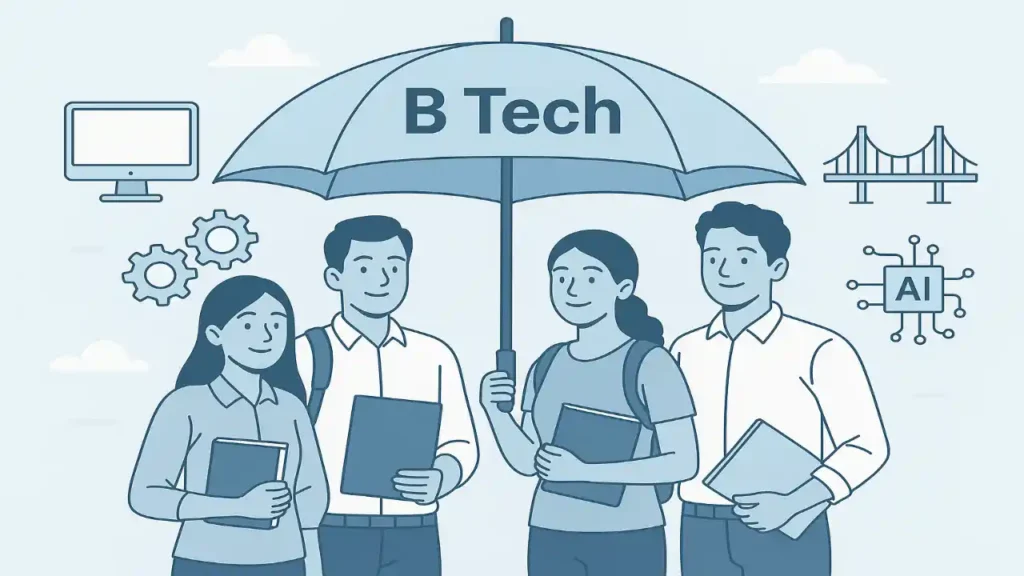
But BTech is not one single course. It’s more like a main umbrella, and under it, there are many different branches.
Each branch focuses on a specific area of engineering, like computers, machines, electricity, construction, or even space.
That’s why asking how many courses are there in BTech is actually the right question — because your branch decides:
- What you’ll study
- What skills you’ll develop
- And often, what career paths open up later
So, How Many Courses Are There in BTech in 2025?
Let’s answer this directly.
In India, there are around 30 to 40 BTech courses (branches) offered across universities and engineering colleges.
Now, don’t get stuck on the exact number.
Why? Because:
- Some branches are core and fixed
- Some are emerging and new
- Some universities rename or combine specializations
But yes, on average, when students ask how many courses are there in BTech, the realistic answer is:
Around 30+ different BTech branches, including core, specialized, and new-age engineering fields.
Now let’s break this down properly.
Types of BTech Courses (Big Picture Overview)
Before jumping into a long BTech branches list, it’s important to understand the types of BTech courses.
Broadly, BTech courses fall into three main categories:
- Core Engineering Branches
- Specialized / Modern Engineering Branches
- Emerging & Interdisciplinary Branches
This classification makes everything much easier to understand.
Core Engineering Branches in BTech
These are the traditional and most popular branches.
Almost every engineering college in India offers these.
List of Core BTech Courses
Some major core branches include:
- Computer Science Engineering (CSE)
- Mechanical Engineering
- Civil Engineering
- Electrical Engineering
- Electronics and Communication Engineering (ECE)
- Chemical Engineering
- Aerospace Engineering
- Metallurgical Engineering
- Production Engineering
These branches form the foundation of engineering education.
If someone asks how many branches in BTech engineering are core, the answer is usually 8–10 main branches.
They’ve been around for decades and still hold strong value.
Why Core Branches Still Matter
Even in 2025, core branches are not outdated.
They simply require skill-based learning instead of rote study.
For example:
- Mechanical engineers work in automation, robotics, EVs
- Civil engineers work in smart cities, sustainable construction
- Electrical engineers are deeply connected to renewable energy
So yes, core branches are still very relevant.
Specialized BTech Branches (Modern Focus)
Now comes the interesting part.
As technology evolved, universities started offering specialized BTech courses focusing on specific industries.
These are not separate degrees — they are BTech degrees with focused specializations.
BTech Branches List – Specialized Courses
Here are some popular specialized BTech branches:
- Computer Science Engineering (Artificial Intelligence)
- Computer Science Engineering (Data Science)
- Computer Science Engineering (Cyber Security)
- Computer Science Engineering (Cloud Computing)
- Electronics Engineering (VLSI Design)
- Mechanical Engineering (Robotics)
- Electrical Engineering (Power Systems)
- Civil Engineering (Structural Engineering)
These branches exist because industries demand job-ready skills, not just theory.
How These Affect the Count of BTech Courses
This is where confusion usually happens.
Someone counts only core branches and says:
“There are only 10 BTech courses.”
Another person counts all specializations and says:
“There are more than 40!”
Both are partially correct.
That’s why, when asked how many courses are there in BTech, the most accurate answer includes both core and specialized branches.
Emerging & New-Age BTech Courses (2025 and Beyond)
This is the fastest-growing category.
Many universities are now offering future-focused BTech branches aligned with new technologies.
Examples of Emerging BTech Courses
- Artificial Intelligence and Machine Learning
- Data Science and Big Data Analytics
- Internet of Things (IoT)
- Blockchain Technology
- Robotics and Automation
- Biomedical Engineering
- Environmental Engineering
- Mechatronics Engineering
- Smart Manufacturing
These branches may not be available everywhere, but their number is growing every year.
So naturally, the question how many courses are there in BTech keeps evolving with time.
Complete BTech Branches List (Consolidated View)
To make things simple, here’s a combined BTech branches list covering all categories.
Major BTech Branches You’ll Commonly Find
- Computer Science Engineering
- Information Technology
- Mechanical Engineering
- Civil Engineering
- Electrical Engineering
- Electronics and Communication Engineering
- Chemical Engineering
- Aerospace Engineering
- Automobile Engineering
- Biotechnology Engineering
- Artificial Intelligence & ML
- Data Science
- Cyber Security
- Robotics Engineering
- Mechatronics Engineering
- Environmental Engineering
- Petroleum Engineering
- Mining Engineering
- Marine Engineering
This list itself shows how many branches in BTech engineering exist when we consider everything together.
Why There Is No “Fixed” Number of BTech Courses
This is important to understand.
There is no single official number because:
- Universities have academic freedom
- New branches are introduced regularly
- Some branches are merged or renamed
So instead of asking for an exact number, it’s better to understand:
- Categories of BTech courses
- Popular and future-oriented branches
- Availability in colleges you are targeting
Still, from an SEO and student perspective, 30–40 BTech courses is a fair and practical range.
How to Choose the Right BTech Course for Yourself
Now that you know how many courses are there in BTech, the next question becomes more personal.
Ask yourself:
- Am I interested in coding, machines, or construction?
- Do I enjoy theory or hands-on work?
- Do I prefer a stable field or a fast-changing one?
There’s no “best” branch.
There’s only the right branch for you.
Final Thoughts
If you reached till here, one thing should be clear now.
When someone asks how many courses are there in BTech, the real answer is not just a number — it’s an understanding.
BTech is a wide field with:
- Core engineering branches
- Specialized technology-driven courses
- Emerging future-oriented programs
Instead of getting overwhelmed by the BTech branches list, focus on what aligns with your interest and mindset.
Engineering is not about choosing the “most popular” branch.
It’s about choosing the branch where you can grow, learn, and stay curious.
And honestly, once that clarity comes, half the confusion disappears on its own.
Frequently Asked Questions (FAQs)

- GEO vs SEO: How AI Search Optimization Tools Increase Organic Traffic Beyond Google Rankings - January 23, 2026
- Why Use AI Search Monitoring Tools in 2026? (Benefits, KPIs & ROI With Examples) - January 22, 2026
- How to Improve Brand Visibility in AI Search Engines in 2026 - January 21, 2026