
These days students always ask, “Guys, actually how many types of engineering courses are there?” And honestly, the first time you see the list, it can look a bit confusing. Civil, Mechanical, Electrical, and then AI, Robotics, Nanotechnology… all look different. I was confused too at first. But don’t worry, in this guide I will explain in a simple way—different engineering branches, types of engineering programs, and the full engineering course list for 2025, so you can decide which path to choose.
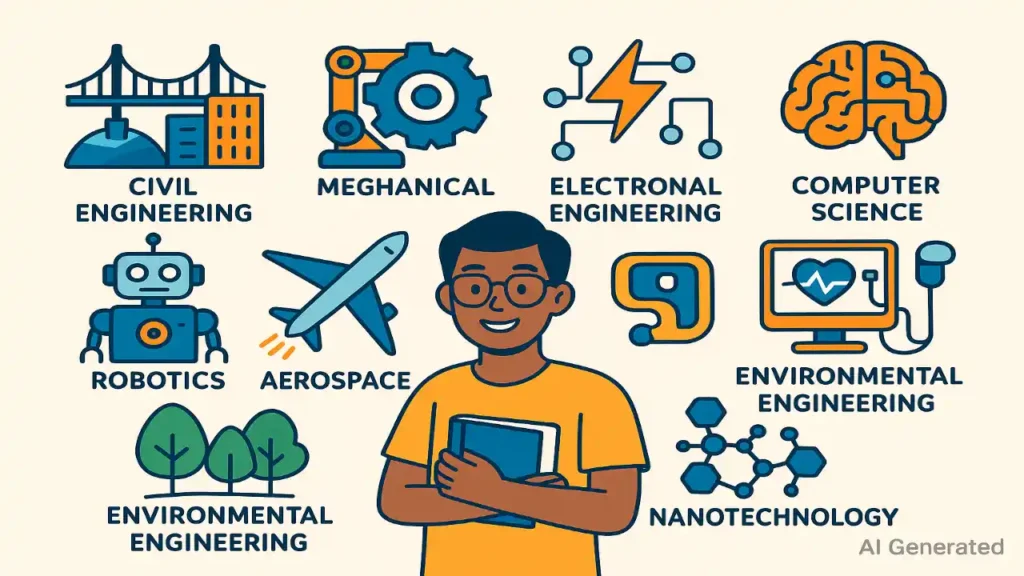
Let’s start, in a friendly style, like I am personally telling you.
Read Also : What Is Information Communication Technology?
Understanding Engineering
First, let’s know what engineering really is. Basically, engineering is a skill for problem-solving, where we use technology, design, and logic. Any bridge you cross, any app you use, or any machine you operate—an engineer made it.
And when a student asks, “how many types of engineering courses are there?”, the short answer is… “a lot!”. But broadly we can divide them into core branches and specialized/emerging branches. Once you understand this, choosing becomes easier.
Different Engineering Branches in 2025
Now let’s talk about different engineering branches. First, I will tell the traditional ones, then the new and exciting courses.
Core Engineering Branches
These are the branches that have always been popular:
- Civil Engineering: Bridges, roads, buildings. If you like design and construction, this is perfect.
- Mechanical Engineering: Machines, engines, automotive systems. Very versatile branch.
- Electrical Engineering: Circuits, electricity, electronics. Good if you like power systems and gadgets.
- Chemical Engineering: Chemicals, fuels, industrial processes. Good if you like processes and industrial work.
- Computer Science & Engineering (CSE): Software, AI, programming. Top choice these days because of demand.
These branches are available in almost all colleges, and considered safe choices.
Specialized / Emerging Engineering Branches
With technology, new courses are also becoming popular:
- Robotics & Automation: Designing robots and automated systems.
- Aerospace Engineering: Designing aircraft and spacecraft. If you like flight and exploration, this is a must.
- Biomedical Engineering: Medical devices and healthcare tech. Biology + engineering combined.
- Environmental Engineering: Pollution control, sustainability. Eco-friendly solutions for the future.
- AI & Machine Learning: Data analytics and intelligent systems. Future-proof choice.
- Nanotechnology: Micro-level materials and devices.
These specialized courses are not available in every college, but demand is growing very fast.
Engineering Course List: Degrees and Programs
When we ask “how many types of engineering courses are there”, it is not only about branches, we should also count degrees and programs.
Undergraduate Programs
- B.Tech: 4-year course, practical oriented.
- B.E.: Same as B.Tech, only the curriculum is slightly different.
- Integrated Programs: Engineering + management combo like B.Tech + MBA.
Postgraduate Programs
- M.Tech: Specialization and research oriented.
- M.Sc. Engg.: For research or niche expertise.
- Master’s in Management of Technology: Engineering + managerial skills.
Diploma & Certification
- Diploma in Engineering: 2–3 years, focus on core skills.
- Certifications: AI, Robotics, CAD, Data Science etc. for skill upgrade.
Tips to Choose the Right Engineering Branch
Now, when the engineering course list is clear, choosing can be a bit tricky. Here are some simple tips:
- Interest & Passion: Like coding? Go for CSE/AI. Like construction? Go for Civil/Mechanical.
- Future Scope: AI, Robotics, Biotechnology are in high demand.
- Skills: Strong in math? Electrical or Mechanical. Interested in biology? Biomedical/Biotechnology.
- Learning Style: Like hands-on projects or analytical work? Choose accordingly.
- Career & Salary: Research which branch has good jobs and salary.
Major Engineering Branches Quick List 2025
- Civil Engineering – Infrastructure, urban planning
- Mechanical Engineering – Machines, engines, automotive
- Electrical Engineering – Circuits, power systems
- Computer Science & Engineering – Software, AI
- Chemical Engineering – Industrial processes, fuels
- Robotics & Automation – Industrial robots
- Aerospace Engineering – Aircraft, spacecraft
- Biomedical Engineering – Healthcare devices
- Environmental Engineering – Pollution control
- Nanotechnology – Micro-level materials
- Marine Engineering – Ships, ocean tech
- Agricultural Engineering – Farming tech, irrigation
- Mining Engineering – Mineral extraction
- Food Technology – Food processing
- Petroleum Engineering – Oil, gas, energy
This list is quite comprehensive, and colleges keep updating these courses according to industry needs.
Emerging Trends in 2025
Engineering is not just limited to traditional branches. Check these trends:
- AI & Data Science integrated in almost every branch.
- Sustainable / Green Engineering: Eco-friendly projects are in high demand.
- Interdisciplinary Programs: Engineering + management, healthcare, design.
- Online & Hybrid Courses: Flexible and short-term certifications.
This shows engineering is continuously evolving, and new opportunities are opening.
Conclusion
So finally, “how many types of engineering courses are there?” The answer is… a lot! Broadly, core branches, specialized branches, undergraduate/postgraduate programs, diplomas, and certifications.
Choosing engineering is not only about numbers, your interest and career goals are equally important. If you keep your interests, strengths, and future goals in mind, choosing the right branch becomes easy.
FAQs
Sources :
Hindustan University – Types of Engineering Courses
BMU – Types of Engineering Courses

- GEO vs SEO: How AI Search Optimization Tools Increase Organic Traffic Beyond Google Rankings - January 23, 2026
- Why Use AI Search Monitoring Tools in 2026? (Benefits, KPIs & ROI With Examples) - January 22, 2026
- How to Improve Brand Visibility in AI Search Engines in 2026 - January 21, 2026