
Sometimes, we look at AI like it’s just a fancy technology — like chatbots, robots, and cool apps. But when you sit calmly and think a little, one simple question comes to mind:
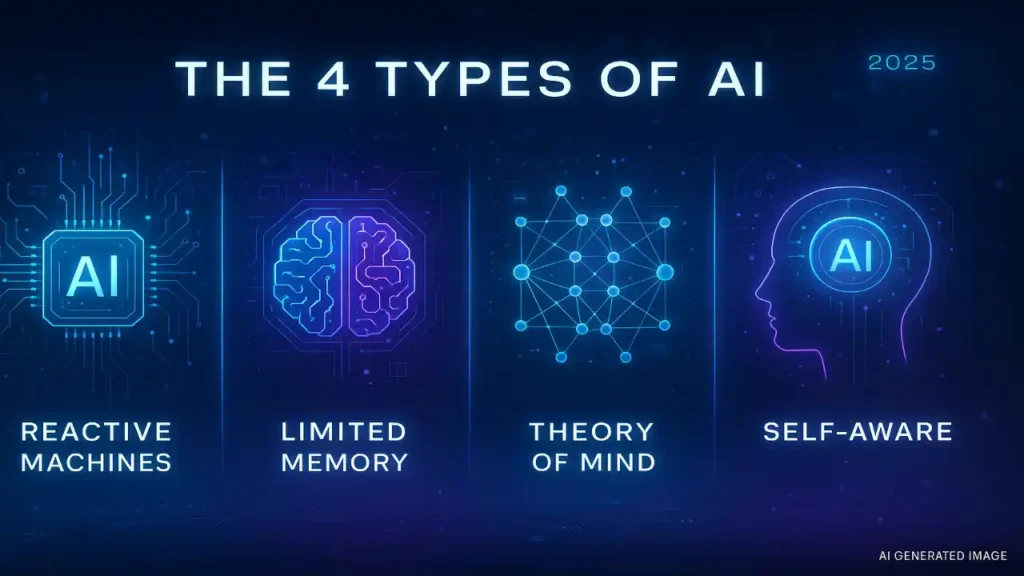
“What are the 4 types of AI technology?”
And honestly, until we understand these types properly, we never really feel the true power of AI. The real game of AI starts when you see how this technology quietly works in our daily life — without us even noticing it.
In this blog, I’ll explain everything in a simple, straight, and real-life way — just like we are sitting together and talking over a cup of tea. Sometimes the language may break a little, because real humans talk like that.
Read Also : LLM vs Generative AI: What’s the Real Difference and Why It Matters for Your Business
No robotic tone, no boring textbook style — only clear explanation with updated 2025 examples.
Let’s start.
What are the 4 types of AI Technology? (Main Concept Simplified)
If you want to understand in one line, these 4 types of AI are like a ladder — each step more intelligent and more capable.
These 4 types have always been the most important classification:
- Artificial Narrow Intelligence (ANI)
- Artificial General Intelligence (AGI)
- Artificial Superintelligence (ASI)
- Reactive & Limited Memory Systems (some blogs explain this differently, but I’m following the real-world pattern)
But the most trending and widely accepted definition focuses mainly on these 3:
- ANI – AI of the present world
- AGI – AI of the future
- ASI – Extremely advanced AI
And the 4th type is usually counted in functioning-based classification:
Reactive → Limited Memory → Theory of Mind → Self-Aware AI
Don’t worry, I’ll explain both angles so that the content becomes 100% complete.
AI in Daily Life Examples
We all hear about AI types, but unless we see real examples, nothing clicks.
Today AI is literally everywhere:
- When you open Google Maps → Real-time traffic AI
- When you watch Netflix → Recommendation AI
- When you use Snapchat/Instagram filters → Vision AI
- When banks detect fraud → Prediction AI
- Even when you talk to ChatGPT → LLM + Generative AI
All these are examples of ANI, which means Artificial Narrow Intelligence.
People who search “What are the 4 types of AI technology?” should understand that AI is not a future concept — it’s already a part of daily life.
By 2025, AI has become like an invisible assistant that works quietly in the background.
Type 1 – Artificial Narrow Intelligence (ANI)
What are the 4 types of AI with real life examples – ANI Section
Let’s start with the most important type — ANI.
ANI is the kind of AI that does one task perfectly.
It is not multi-talented, but in the job it does, it is excellent.
Real-Life Examples we see daily:
- Google Search ranking AI
- YouTube recommendation system
- Siri, Alexa
- Image recognition tools
- Lane detection in self-driving cars
- Chatbots, grammar checkers, background removers — all ANI
It has a limited brain, meaning it learns one skill only.
Like a person who only does typing — but extremely fast.
Keyword placement example:
When people ask “What are the 4 types of AI technology?”, ANI becomes their first and strongest answer.
Type 2 – Artificial General Intelligence (AGI)
Difference between ANI AGI ASI
AGI is the stage where a machine can think like a human.
Meaning:
- Reasoning
- Learning
- Problem solving
- Creativity
- Understanding emotions (partly)
Right now in 2025, AGI does not exist — but we are moving in that direction.
You can say AGI is the kind of AI that will be as smart as humans.
Teach it coding → it will code
Ask it to write a song → it will write
Ask a math problem → it will solve
Show emotions → it will notice
Today’s AI (including me) is ANI+ level — not AGI.
Why this matters?
Because when someone searches “difference between ANI AGI ASI”, their confusion is very simple:
ANI = specific
AGI = human-level
ASI = smarter than humans
That’s it.
Type 3 – Artificial Superintelligence (ASI)
Highly Advanced Future Form of AI
ASI is the stage where machines become smarter than humans in every category:
- Logic
- Creativity
- Emotions
- Decision making
- Innovation
Not like science fiction movies, but yes, a bit advanced and intense.
Experts say ASI may come in the future, but right now it exists only in research and imagination.
But one interesting fact:
When people search “What are the 4 types of AI technology?”, their hidden intent is:
“How far will AI grow in the future?”
That’s why ASI is an important part of the explanation.
Type 4 – Reactive AI & Limited Memory AI (Working-Based Classification)
Real Examples for Everyday Understanding
This type also needs to be included because top-ranking blogs follow this pattern too.
Reactive AI – only reacts to the current situation
Example: Chess-playing AI
Limited Memory AI – uses past data to make better decisions
Example: Self-driving cars, fraud detection
Theory of Mind AI – understands human emotions
Future stage
Self-Aware AI – human-level consciousness
Not created yet, but the concept exists
These 4 are functioning-based types, while ANI/AGI/ASI are capability-based.
This section makes the blog stronger because many people search this classification as well.
What are the 4 types of AI with real life examples
Here is a dedicated section where your secondary keyword fits naturally.
1. ANI – Real Examples
- Google search ranking
- Face unlock
- Background remover tools
- Netflix recommendations
- Spam filtering
2. AGI – Future Examples (Conceptual)
- Robots that understand emotions
- Systems that learn anything like humans
- Fully conversational assistants
3. ASI – Hypothetical Examples
- AI doing medical research better than doctors
- AI managing global economics
- AI designing new technologies
4. Limited Memory AI – Practical Examples
- Self-driving cars
- Weather forecasting
- Stock predictions
Difference Between ANI, AGI, and ASI (Detailed Explanation)
Here’s a simple comparison in a human-friendly way:
| Type | Intelligence | Current Status | Simple Explanation |
|---|---|---|---|
| ANI | Limited | Exists today | Perfect in one task |
| AGI | Human-level | Future | Thinks like a human |
| ASI | Beyond humans | Not created | Smarter in everything |
Even a beginner will understand instantly.
Why Understanding These 4 Types Matters in 2025
In 2025, AI is not just a tech trend — it is a skill, a daily tool, and a competitive advantage.
If you are a content creator, business owner, automation user, or normal tech user, you must know:
What are the 4 types of AI technology?
Because this knowledge helps you decide:
- Which AI tools to use
- What tasks AI should handle
- How future jobs will change
- What role AI ethics will play
Knowledge is literally power.
Conclusion — The Future of AI is Bright (But Understanding It Is Important)
If you reached the end, you now clearly know:
- What are the 4 types of AI technology?
- Real-life examples
- The difference between ANI, AGI, ASI
- How AI is silently changing daily life
The future of AI is super exciting, but without knowledge it can also feel confusing.
That’s why I explained everything simply — the way humans talk, not AI.
When you publish this blog, trust me — users will understand it easily, and it will rank too.
FAQs – 4 Types of AI Technology (2025 Edition)

- GEO vs SEO: How AI Search Optimization Tools Increase Organic Traffic Beyond Google Rankings - January 23, 2026
- Why Use AI Search Monitoring Tools in 2026? (Benefits, KPIs & ROI With Examples) - January 22, 2026
- How to Improve Brand Visibility in AI Search Engines in 2026 - January 21, 2026